Welcome back to Delicious Horror: Silk & Sinew edition! Today, we’re chatting with the always wonderful and fabulous, Lee Murray! Lee is not only an incredibly kind human, but an immensely talented writer. Every piece I’ve read of hers is a captivating work of art.
Also, remember you can pre-order Silk & Sinew with a signed bookplate.
Lee Murray is a writer, editor, poet, and screenwriter from Aotearoa New Zealand, a Shirley Jackson Award and five-time Bram Stoker Award® winner. A USA Today bestselling author with more than forty titles to her credit, including novels, collections, anthologies, nonfiction, poetry, and several books for children, she holds a New Zealand Prime Minister’s Award for Literary Achievement in Fiction, the first author of Asian descent to achieve this, and is an Honorary Literary Fellow of the New Zealand Society of Authors. Her latest work, NZSA Cuba Press Prize-winner Fox Spirit on a Distant Cloud, was released in 2024 from The Cuba Press. Read more at leemurray.info

Title of story in Silk and Sinew:
“The Poppy Cloud” short story
“Charcoal Skies” poem
Tell us briefly about your story and/or the inspiration behind it:
Kindly invited to consider the theme of air as it applies to Asian diaspora folk horror, I was drawn to the concept of our bodies becoming the expression our ancestral lands, the heritage we carry with us wherever we might be, conjuring a story which considers how Chinese women lost their voices, and their agency, as a result of New Zealand’s historic anti-Chinese policies. Based loosely on the Māori legend of Kuirau, with insight into opium addiction, “The Poppy Cloud” blends horror and magical realism. Here is the premise:
When Second Wife arrives in Aotearoa-New Zealand in 1908, a full twelve years after her husband, there is a tax to pay, but already the fare has impoverished her husband. To enter the country, Second Wife must give up her lungs. She fashions a new organ from a battered opium pipe, but the tubes are thin and rigid, making every breath an agony. Second Wife can barely survive on the gasps of poisoned air, let alone speak, not that anyone understands her foreign tongue. But her bitter husband, seeing a way to recoup his losses, opens an illicit opium den in a dingy back room, hiring her out to soporific men who further suck her life breath from her. Isolated and abused, Second Wife’s only escape is into her dreams. But soon the town’s Temperance Women discover the enterprise—illegal since the Opium Prohibition Act 1906—and set out to purge the people of the Peril.
Likewise, “Charcoal Skies”, which also appears in the anthology, is an ‘air’ poem. A terzanelle, it considers the alchemy of gunpowder, an invention commissioned by Emperor Wu and intended as an elixir of eternal life. Instead, the explosions stole the oxygen, the life-breath, from Chinese people even as they built roads and bridges to new lives in foreign lands. Here is an excerpt:
our voices stolen; our lungs scorched to dust
foul corpses laid in monuments of blood
breath after breath after breath after breath
building iron roads across hostile lands
What did you decide to make to pair with the story, and what from the story inspired your delicious food or drink?
“The Poppy Cloud” connects to the legend of Kuirau, a beautiful Māori maiden who lived in Rotorua in the Bay of Plenty, a town not far from where I live. As the legend states, Kuirau, was bathing in the tepid waters of a local lake – then called Taokahu – when a water serpent-monster, a taniwha, grabbed her and pulled her into his watery lair at the bottom of the lake. But Māori gods witnessed the kidnapping and, angered by the audacity of the monster, caused the lake to boil, destroying both the bold taniwha and also the innocent maiden. Today, a park named after Kuirau exists on the same spot at the centre of the city, where the boiling pools and streams still bubble with mud and emit sulphurous steam.

These geothermal pools are an important part of Māori culture, their daily life and their storytelling, as the New Zealand Geothermal Association States:
“For centuries, Māori have recognised and utilised naturally sourced geothermal (waiwhatu) energy for various purposes. They consider these areas as sources of healing, sustenance, and power and traditionally use thermal fluid for bathing and treating various ailments.
Additionally, geothermal (waiwhatu) resources played a vital role in traditional Māori cooking practices. Steam vents, hot springs and heated soils were used for cooking, particularly for the preparation of “hangi” meals. A hangi involves cooking food in an earth oven, utilising geothermal (waiwhatu) steam and heat to impart unique flavours to the food.
Geothermal (waiwhatu) sites and resources also hold cultural and spiritual significance for Māori. They are considered as meeting places between the physical and spiritual worlds, and ancestral stories and legends often connect these areas to the creation and history of Māori people.”
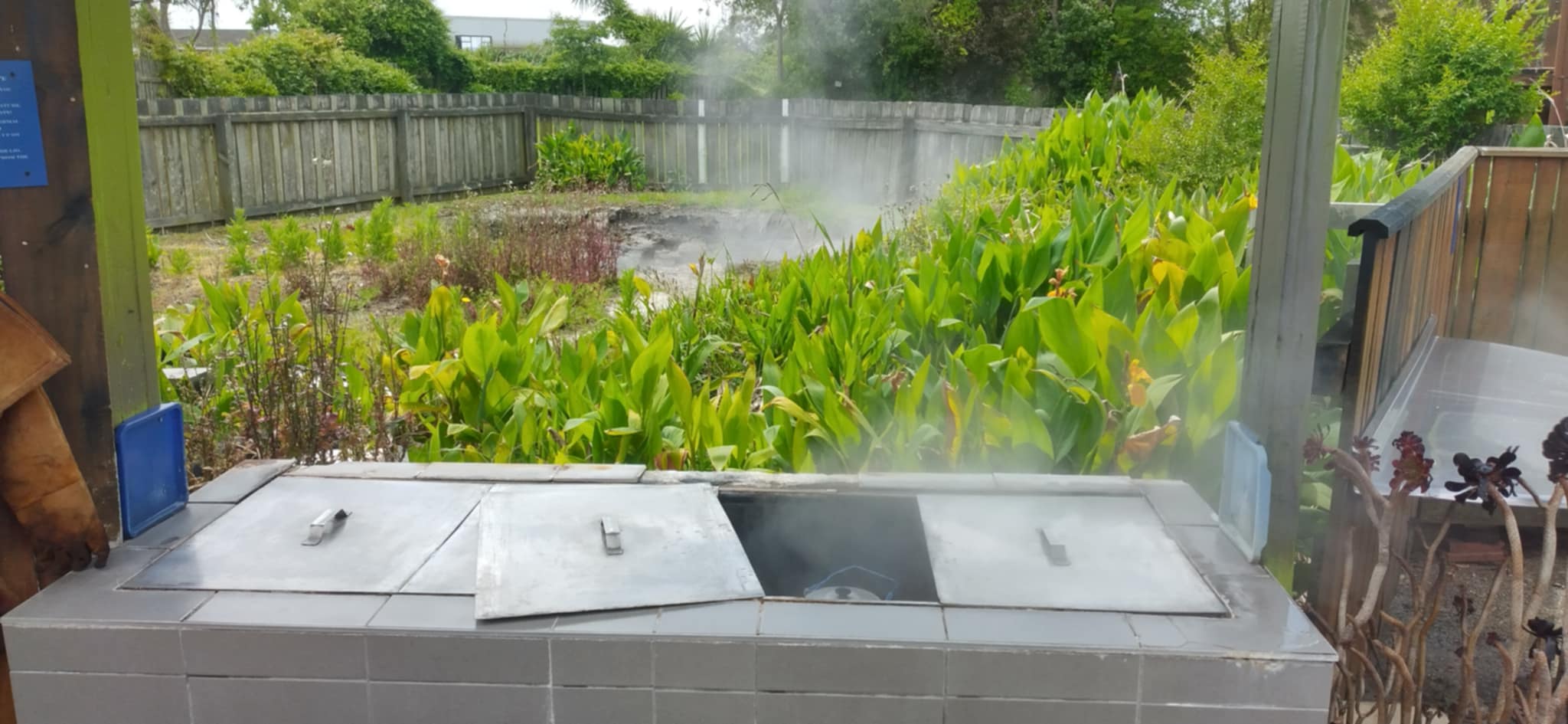
“Meeting places for spiritual and physical worlds…” Isn’t that the very definition of folk horror? But it’s the second paragraph above that has prompted my ‘recipe’ or rather the ‘process’ of using steam to nourish and sustain us, a practice still used by locals to this day. In fact, my friend, speculative writer Grace Bridges, lives just steps from Kuirau Park, and she cooks all her meals, every single one (yes, even her breakfast), in an outdoor steam oven fuelled by the same source that boiled the legendary taniwha. On several occasions, I have visited Grace for weekends and enjoyed fabulous meals cooked in this steam oven.
Here is an image of the steam oven, including the geothermal pool behind it:
And here are some typical foods cooked in the steam oven, including local staples like sweet potato (kumara) and green lip mussels (kuku):
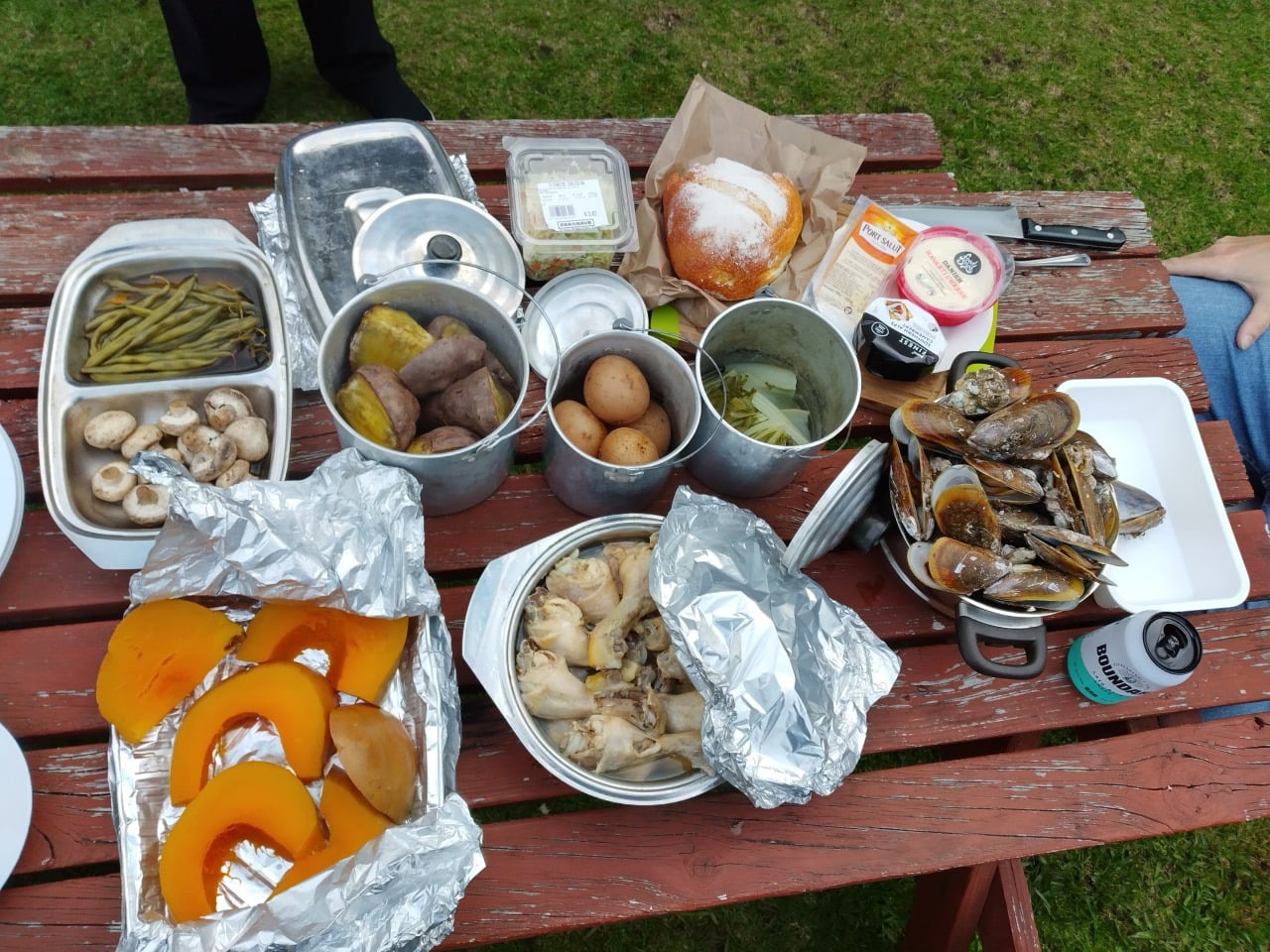
Of course, traditionally, Māori didn’t have metal billies in which to cook their food, instead lowering the food into the boiling pools in flax baskets or wrapping the food in leaves in the case of the earth oven.
I absolutely love this connection between my story and this lifegiving natural source used for centuries by the indigenous people of my country. And of course, steam is a key cooking technique in Chinese cuisine too, with dumplings and delicacies typically steamed in bamboo containers and served straight to the table at yum cha.
Notes:
Links: https://www.nzgeothermal.org.nz/geothermal-in-nz/maori–geothermal/
 Sara Tantlinger