Welcome back! We’re getting down to the final four interviews with authors from Silk & Sinew! Today, I’m thrilled to learn more about Jess Cho and their story in the anthology. I’ve read some of Jess’s excellent poetry before (Happy National Poetry Month, by the way!), and I loved how that sharp poeticism comes through in the rich descriptions found in “Fed By Earth, Slaked By Salt.” Read more below!
Jess Cho is a Rhysling Award winning SFF writer of short fiction and poetry. Born in Korea, they currently live in New England, where they balance their aversion to cold with the inability to live anywhere without snow. Previous works can be found at Fantasy Magazine, khōréō, Fireside Fiction, Apparition Lit, Anathema Spec, and elsewhere. They blog infrequently at semiwellversed.wordpress.com

Title of story in Silk and Sinew:
“Fed By Earth, Slaked By Salt”
Tell us briefly about your story and/or the inspiration behind it:
I wrote my story to the theme of estuary, which is a setting I’ve long been fascinated by. As the point where fresh and saltwater biomes meet to form a new, unique environment, I knew immediately that this was the perfect connection to dig into for an Asian Diaspora anthology, drawing from my own struggles to navigate my way between two identities. Add in folk-horror with a focus on body as land? Even better.
This story went through about a dozen iterations before I finally nailed it down to what appears in S&S, but several of the themes stayed true throughout—homecoming, the trauma of uprooting, the corruption of old rituals and the things we inherit whether we like it or not. I really wanted to lean into the more visceral senses like scent, texture and taste, and spent many hours squashing through the mud of my own local marshes while thinking about how to bring this story to life.

What did you decide to make to pair with the story, and what from the story inspired your delicious food or drink?
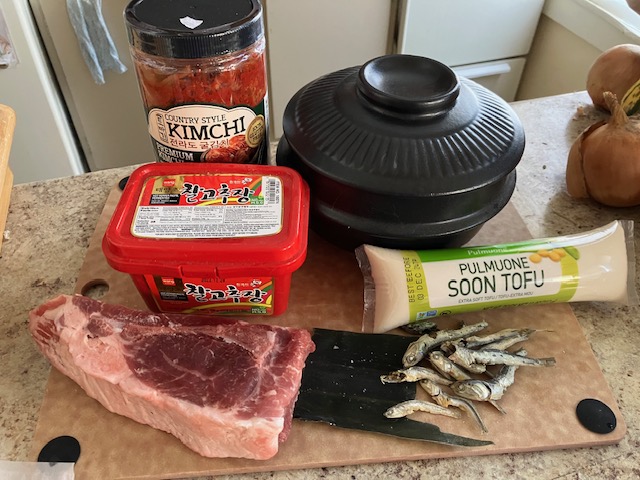
Food and taste both feature pretty prominently in my story, which made it tricky to narrow it down to one thing. I’d originally considered making samgyetang, the chicken and ginseng soup eaten in the story, but the more I thought about it, the more the themes I was going for were embodied by a different dish and I decided to go with sundubu jjigae, a soft tofu and kimchi stew.
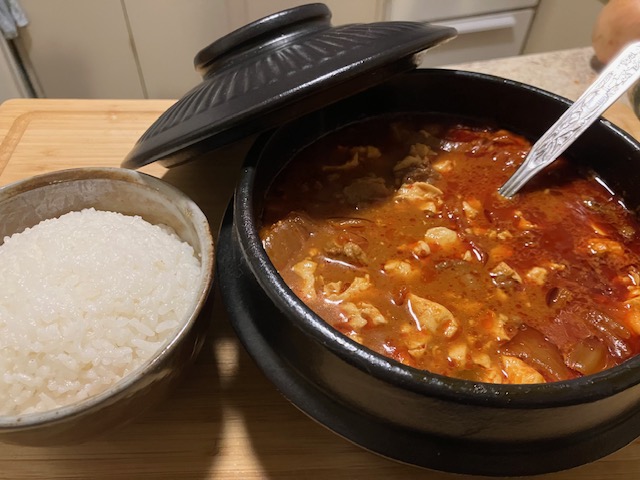
Much like an estuary, sundubu jjigae is a meeting place of flavours, combining a briny broth made from dried whole fishes (which were actually what drove the sensation of biting into tiny fish skeletons in the story’s dream/mud scene) with the earthy richness of pork. Soft, uncurdled tofu gives it the best slippery-weird silt texture and then whole thing is tied together with kimchi. This is also one of the very first Korean dishes I learned how to make and remains one of my favourite comfort foods. Warm and spicy and gorgeously red, it’s everything I want when I think of a homey meal. I tend to measure this one more with the heart than the hands, but the recipe below is more or less what I’ve cobbled together from a variety of different ones I’ve tried over the years. If you want a less haphazard resource for Korean recipes, https://www.maangchi.com/ is an excellent place to start.
Can you share the recipe or a link to the recipe?
Sundubu Jjigae
- 4 cups water
- 8-10 medium dried anchovies (you can use ones with the head and guts removed but I like them left in—they add a little bitterness)
- 1 roughly palm sized piece of dried kelp
- 1 package sundubu, extra soft tofu (silken works in a pinch, but it’s not the same)
- 5oz pork, cut into small pieces (any kind works, I prefer fatty over lean)
- ⅔ cup chopped kimchi
- 1 tbsp gochujang
- Garlic
- 1 tbsp oil
- Soy sauce to taste
- Egg (optional)
- Green onion (optional)
- Add water, dried anchovies and kelp to a pot and bring to a boil over high heat. Reduce heat and cover, let simmer for 20 minutes. Remove from heat, strain and reserve the liquid.
- In a separate pot (a ttukbaegi is ideal if you have one) on medium-high heat, add oil and garlic, stir until fragrant. Add gochujang and pork, cook for another three minutes while stirring. Add kimchi, cook for another few minutes until everything is nicely incorporated.
- Stir in broth until soup-like, leaving enough space in the pot for the tofu later. Cover and let simmer for anywhere from 20-40 minutes, depending on how tender you like your pork. Add more broth as needed.
- Add the sundubu, breaking it up with a spoon. Cover again and let it simmer until everything is heated through. Taste, add soy sauce or fish sauce as desired.
- (Optional) If using a ttukbaegi, remove from heat, crack an egg in and place the lid back on before serving. The heat from the stone will continue to cook the egg until ready to eat. If using a regular pot, add egg and cover but continue to heat until the egg has set.
- Garnish with sliced green onion if desired. Serve with white rice and banchan of your choice.
 Sara Tantlinger