Delicious Horror: J.A.W. McCarthy

Welcome back to Delicious Horror: Silk & Sinew edition! Today, we’re chatting with J.A.W. McCarthy, who I am a huge fan of. I’ve never met a J.A.W. McCarthy story that I did not love, and Sleep Alone is such a fantastic novella. Also, remember you can pre-order Silk & Sinew with a signed bookplate!

Let’s learn more about the author and the story!

J.A.W. McCarthy is a two-time Bram Stoker Award and two-time Shirley Jackson Award finalist and author of Sometimes We’re Cruel and Other Stories (Cemetery Gates Media, 2021) and Sleep Alone (Off Limits Press, 2023). Her short fiction has appeared in numerous publications, including Vastarien, PseudoPod, Split Scream Vol. 3, Apparition Lit, Tales to Terrify, and The Best Horror of the Year Vol 13. She is of Thai and Slovak descent and lives with her spouse and assistant cats in the Pacific Northwest. You can call her Jen on most platforms @JAWMcCarthy, and find out more at www.jawmccarthy.com.

“Guilt is a Little House”

My story is inspired by Mae Nak, a popular Thai folk story about a woman who stops at nothing to keep her family together and is demonized by her community for it. I set the story in the US, centered around second generation Thai immigrants and best friends on the cusp of adulthood. The protagonist, Val, is trapped with her mother on their landlord’s property, where Val envies the landlord’s daughter’s privileged life and freedom. She’s frustrated with her angry, silent mother, the rules that bind her, and the blithe ignorance of those around her, and she can see only one dark path to freedom. 

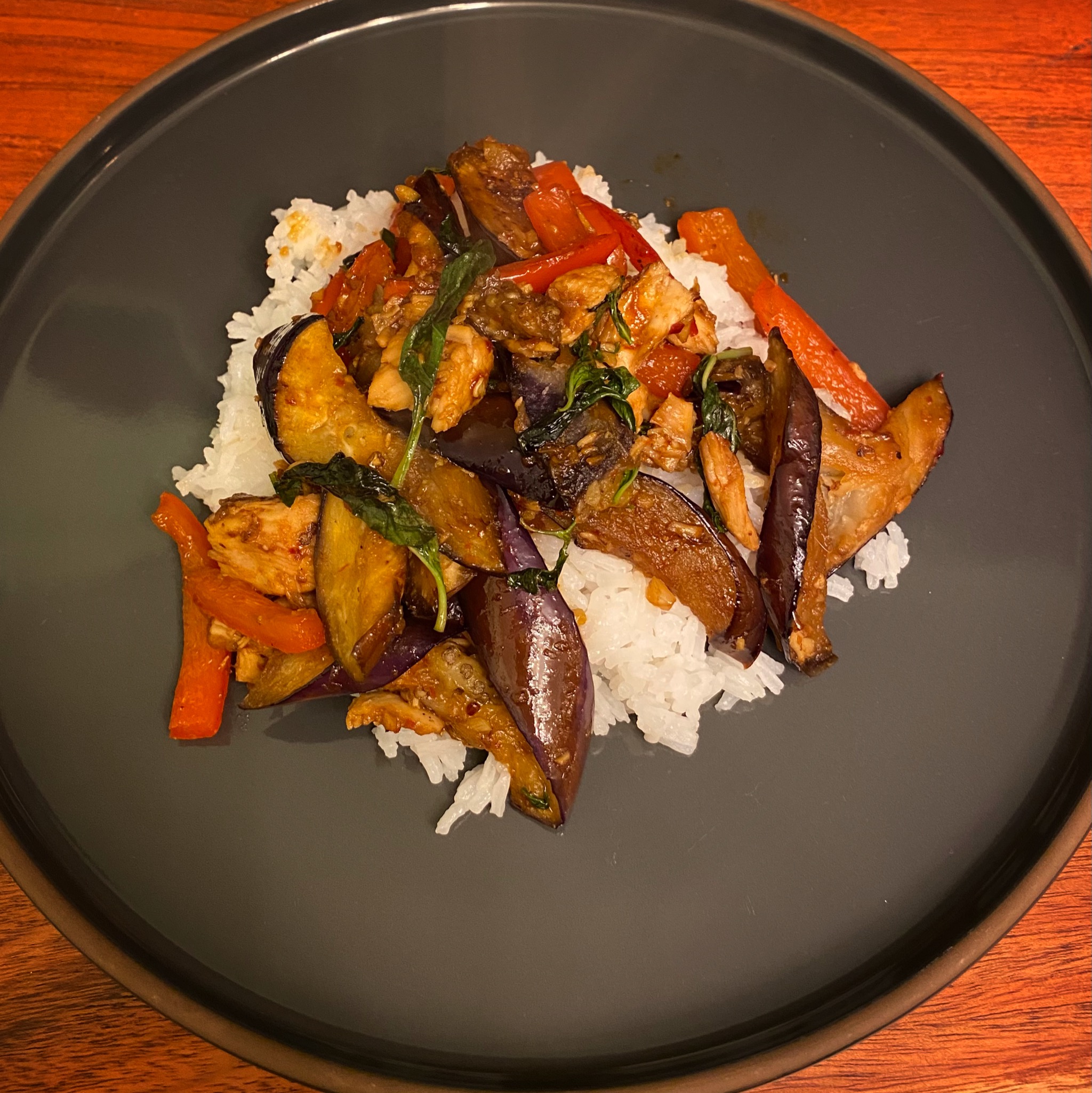
I had to make Thai food since my characters are Thai, and this Eggplant with Basil & Chili Paste Stir-Fry is one of my favorites. Though the original recipe does not contain bell peppers, I always add them for color, and I had to include a red bell pepper this time as a nod to my story (Candace, the housekeeper in “Guilt is a Little House”, always includes something red in every meal). 

https://hot-thai-kitchen.com/eggplant-chili-paste-stir-fry/#tasty-recipes-6401-jump-target

Hot Thai Kitchen is a great resource for Thai cooking—Pailin hasn’t steered me wrong yet. A few notes:

  • For the first sauce ingredient—Thai chili paste—the recipe links to another recipe for a homemade version. If you don’t have time or don’t want to do this, no problem! I use a store-bought Thai chili paste in oil (see photo). It’s delicious, slightly sweet, and only mildly spicy. If you like it spicier, you can always add more Thai chilis, as that’s the source of this dish’s heat.
  • I like to add a teaspoon of brown sugar to the sauce. I enjoy the little bit of sweetness, and it adds great caramelized color to the final dish. Totally optional; just my personal taste.
  • I used diced chicken breast instead of ground chicken because I prefer that. Both are great.
  • Don’t sub Italian/globe eggplant for the Chinese or Japanese eggplant. Italian eggplant has a different texture and more water.
  • Don’t skimp on the Thai basil! Thai basil has a unique licorice flavor that really shines in this dish.

Delicious Horror: Ayida Shonibar

Welcome back to Delicious Horror: Silk & Sinew edition! Today, we’re chatting with Ayida Shonibar. I’m very lucky to have recently received an ARC of Silk & Sinew. I flipped to Ayida’s story earlier today and was hooked with the first line. Let’s learn more about the author and the story!

Ayida Shonibar (she/they) writes dark and wistful speculative fiction about misfits, monsters, mischief-makers. Spanning genres and age categories, their short stories, essays, and poetry have appeared in various publications, including If There’s Anyone Left, Wilted Pages (Shortwave Publishing), Luminescent Machinations (Neon Hemlock), Nature Futures, Night of the Living Queers (Wednesday Books), and Transmogrify! (Harper Teen), among others. You can find more information at ayidashonibar.com.

“An Unholy Terroir”

My story defines monstrosity by the eye of the beholder. For many diasporic folks, identities are influenced by surroundings—including by people who may not understand, appreciate, or care about the contexts immigrants come from. When such perspectives turn into predominant sources of feedback regarding who someone is, these views become all too easy to internalise, to start considering unambiguously true about oneself. “An Unholy Terroir” is a diaspora story about the community environments that (literally) shape us, for better or for worse.

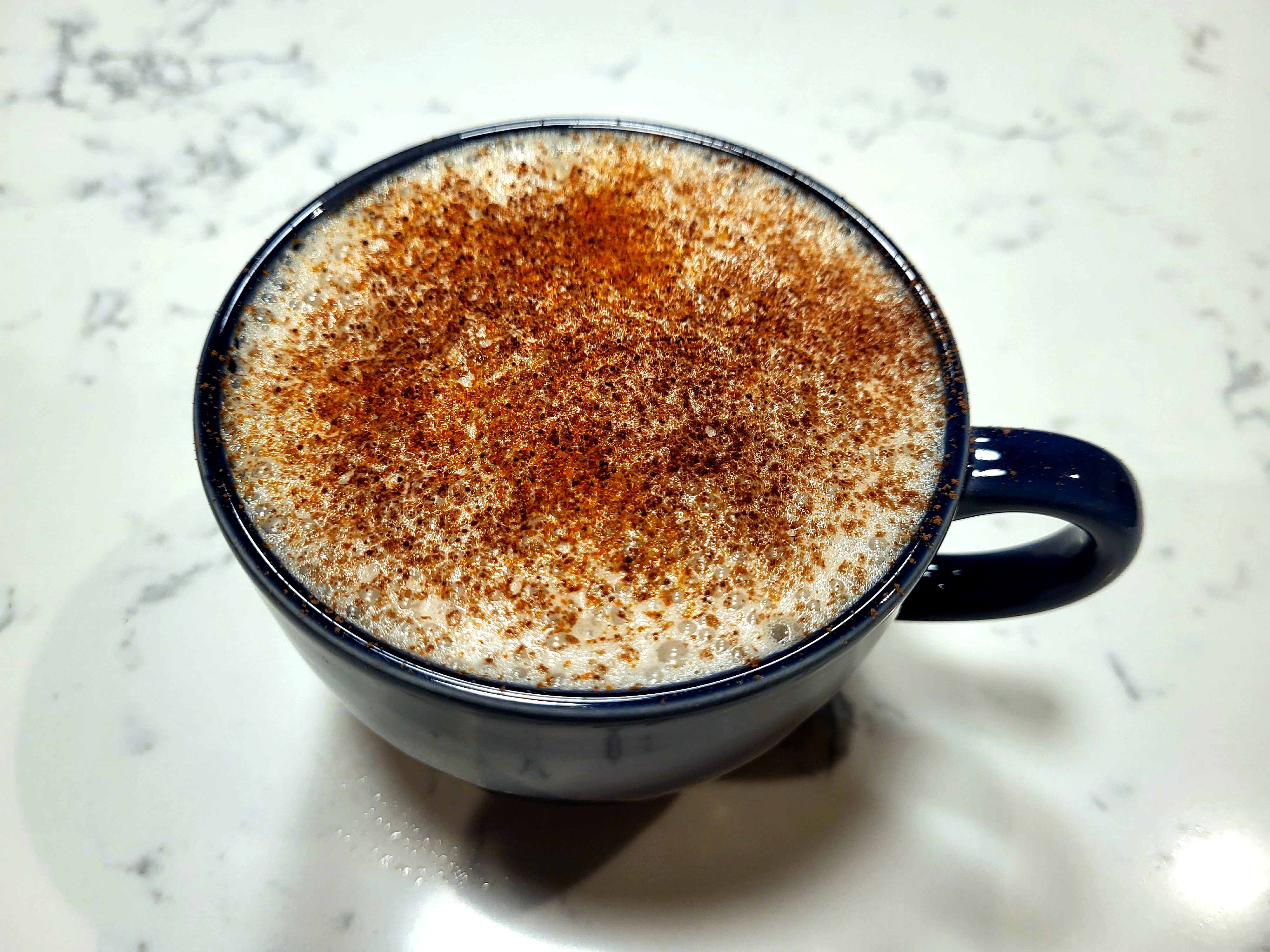
I made an abomination of a herbal tea—fruity blueberry, brewed in a style inspired by masala chai, served with a topping of cocoa and red chilli powder—and I enjoyed drinking it!

I often try mixing ingredients and preparation techniques based on things I like from various cooking traditions. Some of what emerges out of this process can only be described as monstrous. I love fruit teas from all over the world (some of my favourites are pomegranate and orange). I crave spice flavours that make me feel alive. I relish the smooth texture of milky chai. And I adore rich cocoa. The combination of these characteristics blends together perfectly to my taste.

This drink, I imagine, sounds quite off-putting to most people. It only works for me because I already like the individual components from their variety of sources. Every encounter I’ve had with each of them has entrenched the reasons I like them and developed my understanding of what about them appeals to me. Not all things I like fit together in a way I enjoy, of course, but these particular features do. And since my acquired tastes have grown out of the specific experiences I’ve had, they reflect my diasporic journey in a way that might not make gustatory sense to anyone else. That’s how this recipe matches my story in Silk & Sinew.

Ingredients

  • ground cinnamon
  • ground nutmeg
  • ground clove
  • ground green cardamom
  • water
  • milk
  • blueberry herbal tea
  • unsweetened cocoa powder
  • red chilli powder

Steps

  1. In a saucepan, add cinnamon, nutmeg, clove, and cardamom to water. Bring to a boil.
  2. Reduce heat, add blueberry herbal tea and milk, and simmer briefly.
  3. Sieve tea mixture and aerate/froth.
  4. Optional: add additional aerated/frothed milk for a creamier texture.
  5. Sieve cocoa and red chilli powder onto the tea as toppings.

Note: I use approximate quantities of ingredients based on personal taste rather than measuring them out. If unsure, try starting with 0.5 cup of water, 1.5 cups of milk, 1 teabag or equivalent loose leaf, and minimal spices and toppings. A higher water-to-milk ratio intensifies the flavour of the spices. Adjust amounts as needed.

Delicious Horror: Geneve Flynn

Delicious Horror presents recipes paired with stories from Silk & Sinew: A Collection of Folk Horror from the Asian Diaspora, edited by Kristy Park Kulski. First up, please welcome Geneve Flynn!

Geneve Flynn is a speculative fiction editor, author, and poet. Winner of two Bram Stoker Awards and the Shirley Jackson, Aurealis, and Brave New Weird Awards; recipient of the 2022 Queensland Writers Fellowship. Her work has been nominated and short/longlisted for the British Fantasy, Locus, Ditmar, Australian Shadows, Elgin, and Rhysling Awards, and the Pushcart Prize.

Co-editor (with Lee Murray) of Black Cranes: Tales of Unquiet Women, the dark fiction anthology which launched the grassroots movement in Asian women’s horror writing in 2020. Collaborator (with Lee Murray, Christina Sng, and Angela Yuriko Smith) of the internationally acclaimed dark poetry collection, Tortured Willows: Bent, Bowed, Unbroken.

Her work has been published by Crystal Lake Publishing, PS Publishing, Flame Tree Publishing, PseudoPod, and Written Backwards. Geneve serves on the Horror Writers Association’s Diverse Works Inclusion Committee. She is Chinese, born in Malaysia, and now calls Australia home.

Read more at www.geneveflynn.com.au.

“If I Am to Earn My Tether”

My story examines the choices our ancestors make that shape the lives we have: our privilege, advantage, perhaps even guilt. Some decisions are honorable, others less so, but virtually all, I believe, are made for the benefit of the next generation. The question is, how do we live with these choices and what do they say about who we are?

My story also involves sand piracy and colonialism.

Singapore is a glittering edifice of development and business. All this progress requires land. The city-state is also the biggest importer of sand globally, and has increased its landmass by twenty-two percent via land reclamation, sourcing sand from the sea beds and its poorer neighbors, resulting in untold environmental damage and population displacement. I wondered how the land and indigenous peoples might fight back. My answer involves the myth of the polong and pelesit: a tiny female homunculus born from the blood of a murder victim and her pet grasshopper. 

Picture credit: John Leong, Pixabay

There’s a scene at the beginning of the story where the main character meets with a sand broker. The two men are in an open-air market and the broker is enjoying his breakfast of coffee and coconut jam (kaya) slathered on toast. This is an iconic breakfast in Singapore, and usually includes a couple of creamy soft-boiled eggs seasoned with soya sauce and white pepper, for dipping. The coffee is sweet and strong and made with evaporated milk, and the warm kaya toast encloses a heart-stopping slab of cold butter. The combination may sound odd but it really works. It’s a dreamy amalgamation of salty, eggy, buttery, peppery, coconutty goodness.

Here’s the link and YouTube video for the overall recipe. You may be able to buy a jar of coconut jam from an Asian supermarket; if you can’t and would like to try your hand at making kaya yourself, check out the third link below.

Delicious Horror: Tiffany Michelle Brown

It’s been a little while, but I am delighted to share a new post today that I think you are going to love. Plus, it’s the first of October, and what better way to kick off spooky season than with some horror and tasty treats?

Thank you so much to Tiffany for sending this my way!

About Tiffany:

Tiffany Michelle Brown is a California-based writer who once had a conversation with a ghost over a pumpkin beer. Her fiction has been featured by Sliced Up Press, Fright Girl Summer, Cemetery Gates Media, Ghost Orchid Press, D&T Publishing, Frost Zone Press, and the NoSleep Podcast. She is the author of Easy as Pie, a Southern Gothic short story about love, death, and the consequences of holding on too tightly to memories (available in ebook format via Amazon). She lives in San Diego with her husband, Bryan, and their pups, Biscuit and Zen, and is working on her first short story collection.

Tell us what horror book you chose to highlight and why it’s a favorite of yours:

I chose Things Have Gotten Worse Since We Last Spoke by Eric LaRocca, a novella I greedily consumed in a single sitting on my birthday earlier this year. It was a wild, nostalgic, gross ride, and it’s one of those books that stays with you, in part because it evokes such potent and terrifying imagery.

I’m also a sucker for a story that begins with something innocuous – like a vintage apple peeler – and transforms it into something you’ll never look at the same way again in real life. I recently spotted a vintage apple peeler on a TV show and did a double take. It was this cute scene where a couple was making an apple pie, and I basically started screaming at the screen, telling them they needed to get that devil contraption out of their home as soon as possible.

What did you decide to make to pair with the book, and what from the book inspired your delicious treat?

There are three things that immediately come to mind when I think about this book: eyeballs, apples, and tapeworms. So, my dark little heart decided it wanted to make caramel-apple butter “eyeball” truffles and crispy, crunchy “tapeworm” baklava. Yummy!

Can you share the recipe or a link to the recipe?

A little foreword before we get into all the baking shenanigans! There are two main components involved in this bake – the truffles and the baklava. One is pretty dang hard and the other is fairly easy.

The eyeball truffles were my first attempt at any kind of chocolate work, and let me tell you, it was difficult! I have a newfound respect for folks who specialize in chocolate. Like, whoa.

If you enjoy a challenge, you’re cool with things not always turning out just right, and/or you’re a baking masochist (this is very on brand for Things Have Gotten Worse Since We Last Spoke), make those truffles! If you’re not into complicated bakes, buy some white chocolate truffles, decorate them to look like eyeballs, and voila, you’re halfway done!

On the other side of the spectrum, I found the baklava very accessible and delicious, so let’s dive into that recipe first.

Crispy, Crunchy “Tapeworm” Baklava

This was my first time making baklava, so my goal with this portion of the bake was to find the simplest, most accessible recipe possible. Y’all, I did, and it’s a great one!

Here’s the text-based recipe: https://www.dimitrasdishes.com/baklava-spirals/

And there’s a video, too: Baklava Spirals: Dainty & Delicious!

I found the video extremely helpful. It’s short, direct, and gave me the confidence I needed to work with store-bought phyllo dough.

Pro tip, if you buy frozen phyllo dough, you’ll need to defrost it in the refrigerator first and then allow it to come up to room temperature before you work with it. Both of these steps take hours, so plan your baking accordingly!

Another tip: This recipe doesn’t call for any salt, so I added some to the nut mixture to give the filling a little more depth and to take the edge off the inherent sweetness.

I wound up with an excess of the nut mixture, but if this happens to you, fear not. It is delicious sprinkled over the top of the final baklava. In the future, I’d make extra just to have this to top the pastries. It’s a nice textural component and adds flavor, too!

Lastly, this recipe makes a lot of baklava – about 24 pieces! If you don’t plan on sharing with friends, family, or neighbors, you could half the recipe and have plenty of treats for a couple or small household. 

Caramel-Apple Butter “Eyeball” Truffles

First, I made the filling. I melted ¼ cup caramel, added in equal parts warmed apple butter, mixed vigorously to combine, and let the mixture cool completely in the fridge.

If you want to make your own apple butter, here’s a great Instant Pot recipe:  https://easyweeknightrecipes.com/instant-pot-apple-butter/. If you don’t have an Instant Pot, you can absolutely make apple butter on your stovetop. You’re essentially cooking down apples with warm, wonderful spices and then whizzing the mixture up until it’s smooth. (And any leftover apple butter you have can be used on PB&J sandwiches, pancakes, ice cream, etc.)

For truffle assembly, I used these instructions: https://fatdaddios.com/inspiration/how-make-chocolate-truffles

Can we take a moment to read that warning at the top of this webpage? “If you have never worked with chocolate before I wouldn’t recommend starting with molded truffles. It would be like tackling a wedding cake for your first cake decorating experience.” Um, oops. Haha! I’m in this picture, and I don’t like it. But also, challenge accepted!

I used silicone molds that I bought on Amazon, and I love them. Easy to use, easy to clean, cheap. Highly recommend.

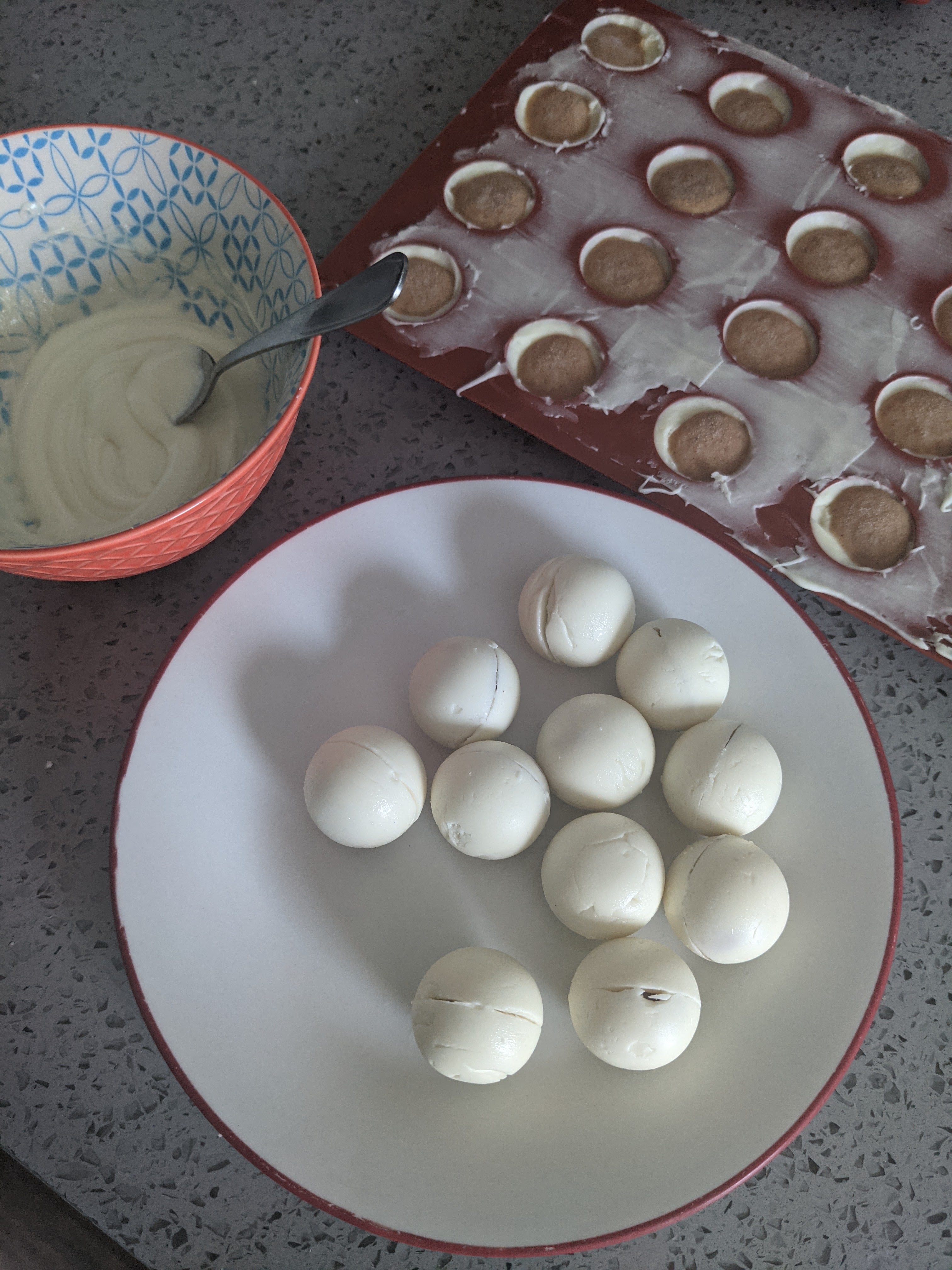
I used Ghirardelli white chocolate chips to create the chocolate shells for these truffles, and I found the tempering method outlined on the Fat Daddio’s website above really helpful. For my first batch, I melted ¾ cup of chocolate in the microwave (in 20 second increments and stirring in between) and then added another ¼ cup of chocolate and stirred, stirred, stirred for about seven minutes to get the chocolate to the right temperature and consistency (see the details on the Fat Daddio’s webpage). If you’re going to pipe the melted chocolate into your silicone molds, work fast! Halfway through, my chocolate started hardening, and it was no longer pipeable. But it was still soft enough to work with, so I started pressing the chocolate into the molds with a spoon, and that worked out just fine! If, like me, these are your first truffles, don’t be afraid to create thicker chocolate shells. They’ll be easier to work with, and you can always finesse your chocolate work and get fancy down the line.

After I added the chocolate into my molds, the freezer became my best friend! The cold set the chocolate beautifully, and it made it really easy to remove the shells from the silicone molds.

After the chocolate hardened, I added cold caramel-apple butter filling to the chocolate molds with a small spoon, and then popped them right back into the freezer. When everything was nice and frozen, I donned some nitrile gloves (to reduce the amount of body heat I transferred to the chocolate while handling it), popped the chocolate out of the molds, and poured some hot water into a mug. Then, I pressed a truffle half to the cup for a few seconds to melt the edge of the chocolate and joined two truffle halves together to create a sphere. Be careful not to over-melt the chocolate on your mug. You really only need a couple seconds of heat and a soft press to join the truffle halves. When all the halves are joined, pop the spheres back in the freezer to set.

When the truffles were set, I got gloved up again and used food-safe, edible-ink markers (also purchased on Amazon) to decorate them with pupils and irises. The markers work best on dry surfaces, so you may need to pat your chocolates dry before you draw. Only decorate the truffles you plan to serve immediately as any kind of moisture will likely result in the ink running (though maybe runny eyeballs would add an extra level of terror!).

The apple butter-caramel mixture has a good amount of liquid in it, so I’d recommend storing these truffles in your fridge or freezer. Of course, you can fill these bad boys with whatever filling you’d like – jam, chocolate ganache, buttercream, etc., so have fun!

Thank you so much again to Tiffany! This was such a delightful walkthrough to read of how she made this terrifying and tasty treat. If you want to submit your own Delicious Horror post, read how to do that right here!

Delicious Horror: StokerCon 2021 Bonus Drinks!

I recently had the fun opportunity to chat with my friends Cynthia Pelayo, Gaby Triana, and Nicholas Diak about making a few drinks worthy of a horror-filled weekend for virtual StokerCon. See what we mixed up below!

The wonderful Gaby Triana has contributed the tasty Bourbon Sour Blood Orange seen below. You can find the recipe she used here! Gaby also put everything together in a video over on her channel The Witch Haunt, you can find it here!
Ingredients:

  • 1 oz blood orange juice
  • 2 1/4 oz bourbon
  • 1 oz simple syrup
  • 1 oz lemon juice
  • 1/2 oz lime juice
  • 1 maraschino cherry

The lovely Cina Pelayo has mixed together two of my favorite things, vodka and coffee. I definitely need to try this! Enjoy the recipe below from Cina:

Unofficial StokerCon Coffee Martini Recipe 
2oz vodka of your choice, I used Kettle One
2oz coffee liqueur of your choice, I used Kahlua blonde roast style, rum & coffee liqueur
2-3 oz of chilled espresso
Add ingredients to shaker (with ice)
Add to chilled martini glass”

And next we have the King of Cocktails, Nick Diak! Nick makes some seriously creative drinks, and it’s always so fun to see what he’s up to.

From Nick: “This is, hands down, my favourite tiki drink.

.75 oz Lemon Hart 151 Rum
2 oz Lime Juice
1 teaspoon of lemon juice
1.5 oz of Passion fruit syrup
.25 oz of Demerara Sugar Syrup
*.25 oz Luxardo Maraschino Liqueur
1.5 of Denizen 8 Rum

*Demerara Sugar Syrup is a simple syrup made with Demerara Sugar. Simply dissolve 1 part sugar into 1 part water. Do 2 parts sugar to 1 part water to make Rich Demerara Sugar Syrup. 

Put all ingredients except the Lemon Hart 151 into a cocktail shaker. Add a few pebbles/bits of crushed ice. Shake until ice dissolves. Pour into a double rocks glass. Fill with crushed/pebble ice. Float the 151 rum on top. 
MOST AMAZING DRINK EVER. Dangerous and delicious.”

Oh, and me! I made what I’m calling the Sloe Bleed due to the Sloe Gin + if you spill this, it certainly bleeds everywhere. Not that I know that from experience…

Ingredients for the Sloe Bleed:

1.5 ounces Sloe Gin
.5 ounces Heering Cherry Liqueur
1 tsp lemon juice
1 dash Peychaud’s bitters

Shake together and then add on club soda and any desired ice — it should be nice and foamy!

If none of these float your boat down into Pennywise’s sewer, check out the other contributions over on Delicious Horror for some more drink and snack ideas that would be perfect for StokerCon weekend!

Delicious Horror: Patrick Tumblety

Welcome back to another amazing submission for Delicious Horror! Today I’m joined by Patrick Tumblety who has chosen to highlight the wonderfully talented Laurel Hightower and her novella, Crossroads. This novella is such a great example of Hightower’s talent and overall power with words. I was excited to see someone submit a post for Crossroads, and just wait until you see what Patrick has created! And if you feel inspired, find out how to submit a Delicious Horror post of your own here!

About Patrick:

“When I’m not baking with my daughter, I’m writing horror, science-fiction, and poetry. I have been featured in a variety of publications, including Tales of Jack The Ripper by Word Horde Press, Gothic Fantasy: Science-Fiction Anthology by Flame Tree Publishing, Fossil Lake, edited by Christine Morgan, and many other anthologies and magazines. My latest publication is in Ghost Orchid Press’s 100 Word Horror: Cosmos, releasing in May 2021. I currently live with my wife, daughter, and cat in Delaware.”

Tell us what horror book you chose to highlight and why it’s a favorite of yours:

Crossroads by Laurel Hightower was the first book I read (listened to) in 2021, and it set the bar for horror (and non-horror) extremely high. I feel bad for every other book I will read this year.

Chris has lost her son to a tragic car accident at a local crossroads. When blood from a small cut on her finger is absorbed by the ground where she has built his memorial, an idea is absorbed into her mind. She knows the legend of the “Crossroads Demon,” where a deal can be made to grant a wish. What does she have left but to find out if the legend is true? She only has her life to trade – a price she’s more than willing to pay to resurrect her son.

There was not one decision Chris makes through her journey (downfall?) that I would make differently. The entire time she (and the reader) knows that her grief is driving her magical thinking, and yet what else does she have to do but take the chance? Laurel Hightower makes you feel just how terrifying it is to have nothing left to lose.

This is the kind of story that scares the HELL out of me. Horror borne from tragedy. Having to live through a world that doesn’t care what it has taken from you. I had trepidation about using this book as the subject for this post, since it’s such a realistic terror. The loss of a child is the most horrifying tragedy that could ever happen. Laurel handles this situation with compassion and honesty, and I by no means want to make light of the subject, rather, I’m using this post to celebrate the book as an incredible piece of horror literature. 

What did you decide to make to pair with the book, and what from the book inspired your delicious treat?

The story depicts burial and burrowing into the ground, so I already had an earthy taste on my tongue while reading it. For holiday parties, I like to make “dirt.”

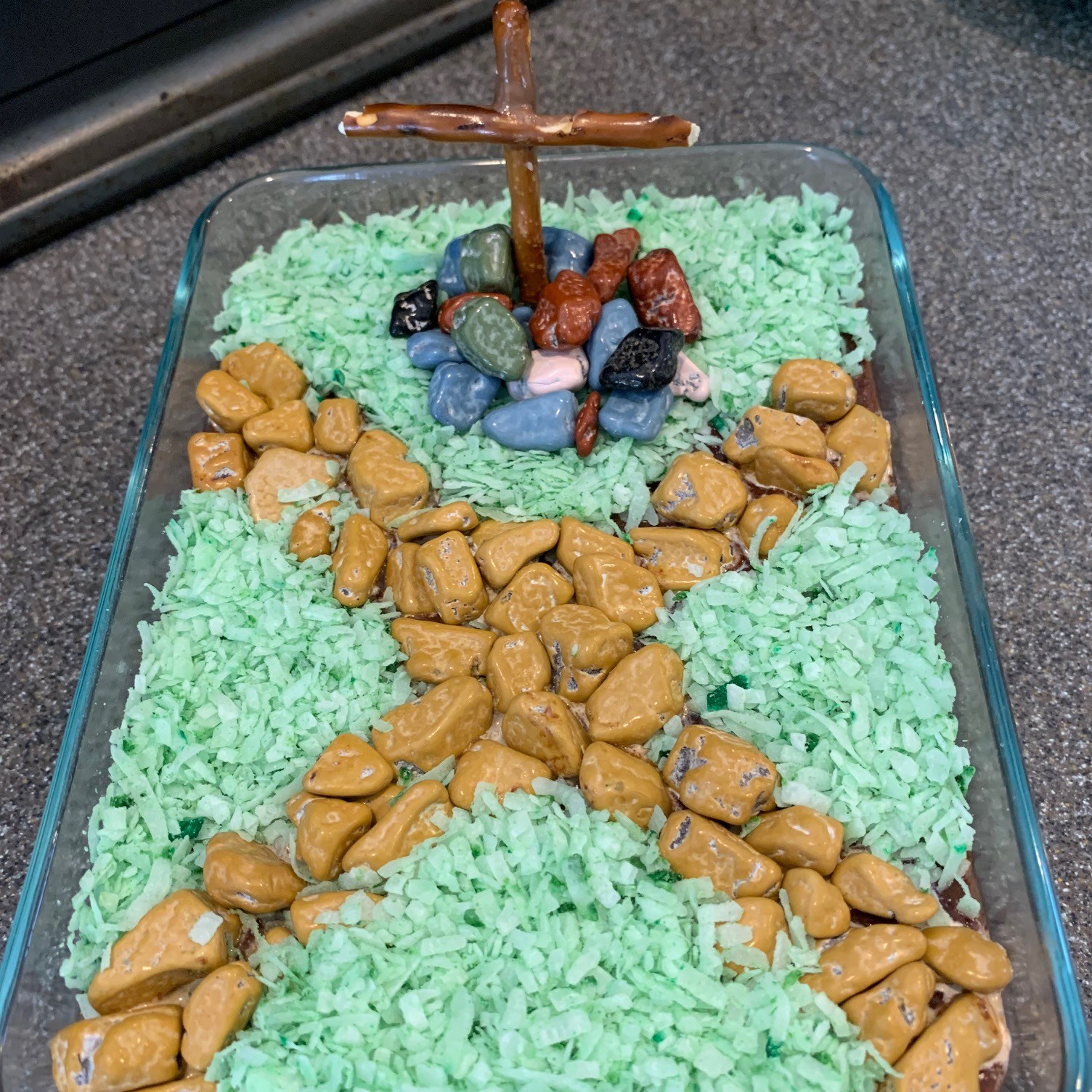
I layer chocolate pudding, grounded up Reese’s cups, and green coconut shavings to make the dish look like a lawn. For Halloween, I include gummy skeletons in the bottom puddling layer and pumpkin-shaped candy corn on top to make a pumpkin patch. For easter, I hide chocolate eggs. For this book, I made the Crossroads. It’s a simple recipe that children have fun putting together, which makes the pairing with this story that much creepier!

Can you share the recipe or a link to the recipe?

The recipe for “dirt” is easy, which allows your imagination to be the main ingredient! I use chocolate instant-pudding for the base (dirt), and topped that with coconut shavings dyed green with food coloring. (You can place anything in between those layers as the “crust” – ground up Reese’s cups, pretzel sticks, heath bar, peanuts, etc). It’s that easy!

To make this Crossroads-inspired piece, I used chocolates from my local market that are candy-coated to look like rocks. My daughter and I picked out the brown rocks and then arranged them on top of the pudding to make the crossroads. We filled the rest of the surface in with the coconut shavings to make the grass. I made the memorial by piling rocks around a cross made of pretzel sticks, glued together by melted chocolate.

A dessert created in honor of Laurel Hightower’s Crossroads!

Thanks for reading! I’m always excited to dig into (pun intended) and spread the word about a great book. Hopefully, you too will find Crossroads a terrifying delicious read!

Thank you so much to Patrick for sharing this on Delicious Horror! Until Next time! Stay spooky and go create some tasty treats to honor your favorite authors and books. -Sara

Delicious Horror: Jacqueline West

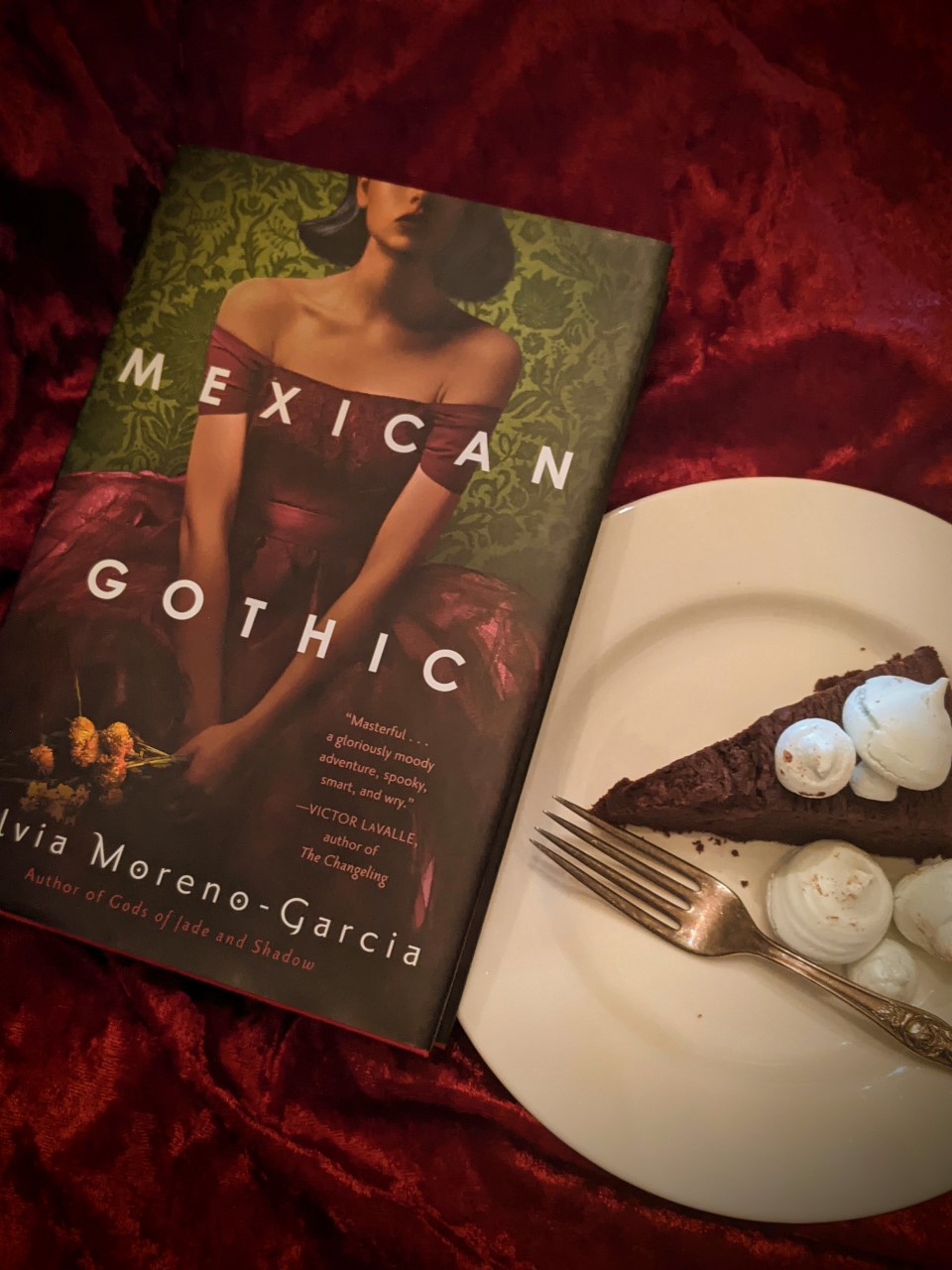
I have a wonderful submission for Delicious Horror today that I am so excited to share with you all! Author Jacqueline West has paired Mexican Gothic by Silvia Moreno-Garcia with a very tempting treat. I read Mexican Gothic a few months ago and was completely immersed in the rich storytelling, so I was thrilled to see Jacqueline’s pairing. Enjoy!

Jacqueline West is the author of the New York Times-bestselling middle grade series The Books of Elsewhere, the Schneider Family Honor Book The Collectors, and several other middle grade and young adult novels of the dark and twisty variety. Her most recent book, the YA horror novel Last Things, was a finalist for the Minnesota Book Awards and was selected for the Bram Stoker Awards preliminary ballot, and her next book, the MG ghost story Long Lost, is forthcoming from Greenwillow/HarperCollins in May 2021. Jacqueline’s poetry and short fiction for adult readers has appeared in Mythic Delirium, Strange Horizons, Goblin Fruit, Liminality, Mirror Dance, and Star*Line. Her first full-length poetry collection, Candle and Pins: Poems on Superstitions was published by Alban Lake in 2018. Jacqueline lives with her family in Red Wing, Minnesota.  

Find Jacqueline at www.jacquelinewest.com or on Instagram @jacqueline.west.writes and Twitter @JacquelineMWest

Tell us what horror book you chose to highlight and why it’s a favorite of yours: 

I just read—and loved—Silvia Moreno-Garcia’s latest novel, Mexican Gothic. Its imagery has been fixed in my brain ever since: Foggy forests, private cemeteries, molding wallpaper, crumbling ancestral homes filled with horrifying family secrets. The book is gothic in all the classic ways, but it’s infused so craftily with elements that make it its own, like the rural Mexican setting, the effects of colonialism, the ways that some husbands and fathers turn their families into their own brutal little kingdoms. And the protagonist, Noemi Taboada, is GREAT. She’s not the naïve and innocent Mrs. DeWinter-ish gothic heroine, and she’s not the reserved and unassuming Jane Eyre type, either. She’s completely herself.  

What did you decide to make to pair with the book, and what from the book inspired your delicious treat? 

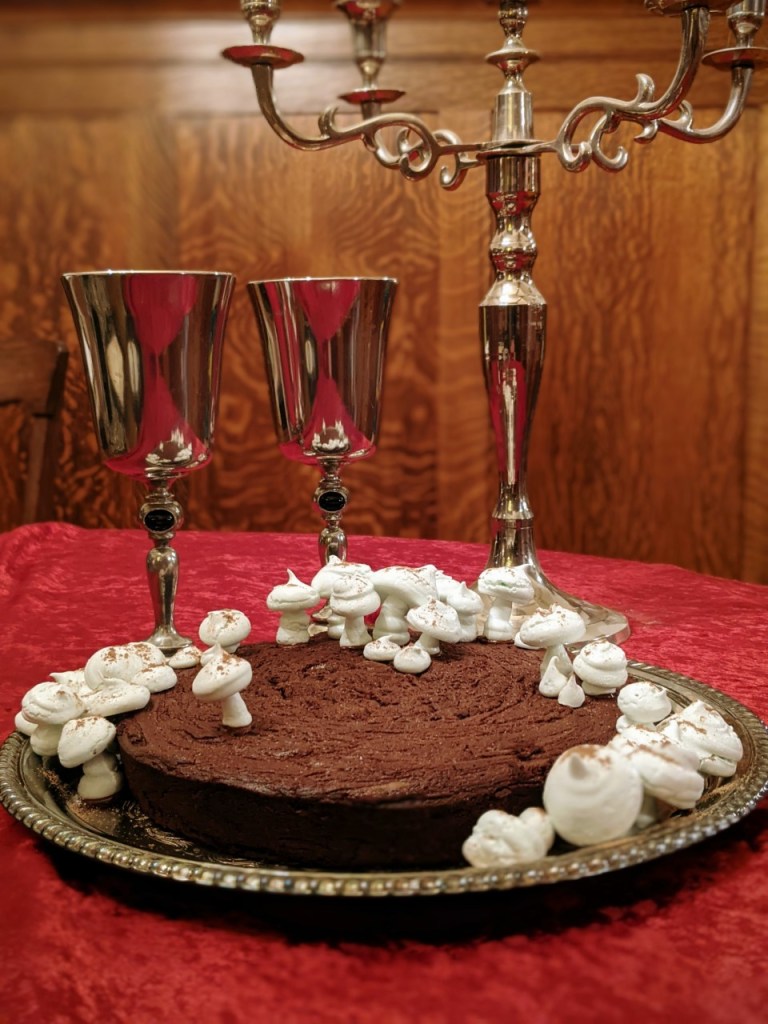
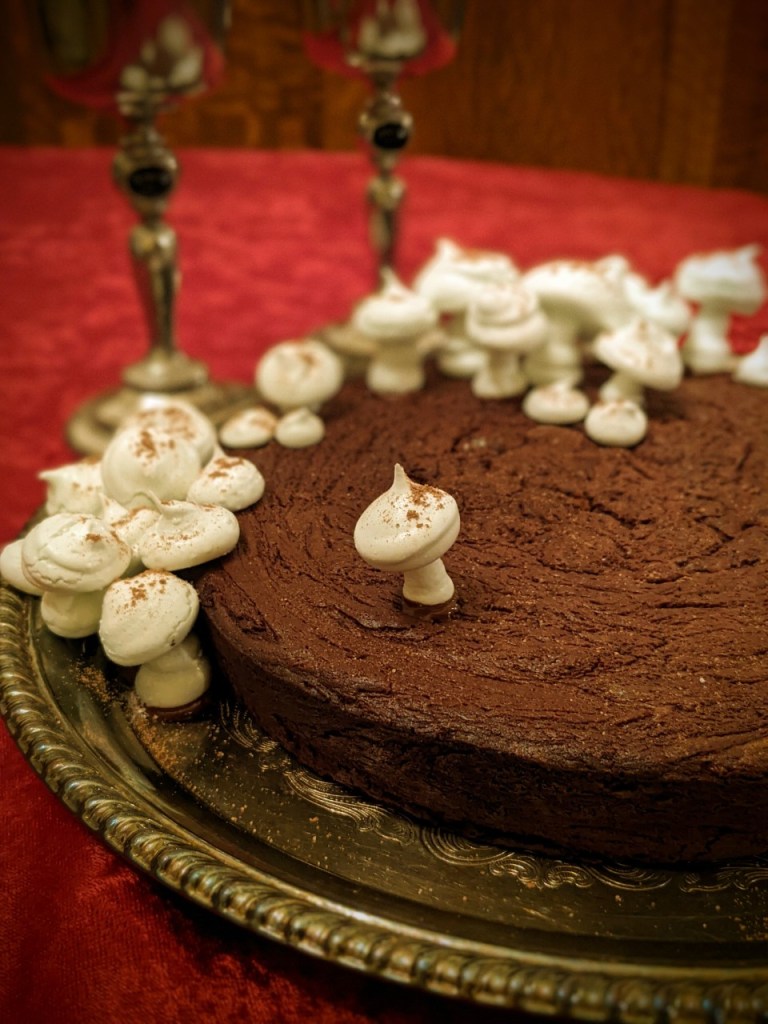
Chocolate Socialite Cake with Meringue Mushrooms felt like the perfect fit. Mold and fungus are an important element of Mexican Gothic’s setting. Inside the Doyle mansion, mold covers the walls and infuses the air, and outside, mushrooms sprout from the graves of the family cemetery. The fungus is also a symbol for the family at the heart of the story: this vast system of interconnected organisms that feed on death and decay. So there had to be meringue mushrooms. And bittersweet Chocolate Socialite Cake seemed right for Noemi, a wealthy party girl from Mexico City who’s a lot deeper and stronger than she’s given credit for. Plus, the two recipes fit together with weird perfection—the cake uses egg yolks, and the meringue uses egg whites, so there’s a sort of mushroomy symbiosis happening. More symbolism!  

Can you share the recipe or a link to the recipe? 

I found the cake recipe in a magazine forever ago, and I can’t remember the source’s name, but she was some wealthy and fashionable socialite who mentioned having served this to Andy Warhol. In my notebook, I wrote it down as “Chocolate Socialite Cake.” And the meringue mushrooms come from Martha Stewart. (You can add a few drops of food coloring along with the vanilla flavor, if you want your mushrooms tinted an eerie green or yellow.)

Chocolate Socialite Cake:
2 sticks unsalted butter, plus more for buttering the pan
4 bars (3.5 oz. each) of good quality bittersweet or dark chocolate, broken into pieces (I’ve used Lindt and Ghirardelli; Ghirardelli bittersweet chocolate chips work too)
3 whole eggs
3 egg yolks
1/3 cup sugar
½ cup all-purpose flour 

Preheat oven to 350.
Butter a 9-inch round pan.
Melt butter and chocolate together in a heat-safe bowl over a pan of hot water, or melt in short increments in the microwave, stirring frequently. Once chocolate is smooth, set aside.
In another bowl, with an electric mixer, beat eggs and egg yolks until frothy. At medium speed, beat in sugar until creamy. Beat in flour.
Fold flour mixture into chocolate mixture with a rubber spatula until blended. Spread in buttered pan.
Bake until set in the center, roughly 40 minutes. Let cool.
Top with meringue mushrooms and/or berries and whipped cream, and serve on a tarnished silver platter. 

Easy Meringue Mushrooms: https://www.marthastewart.com/347008/meringue-mushrooms 

Thank you so much Jacqueline for this excellent post! If you feel inspired, find out how to submit a Delicious Horror post of your own here!
Delicious Horror: Michael Arnzen

What a month! I can’t believe it’s Halloween Eve and October is almost gone. I have enjoyed the Delicious Horror series so much, and I hope you have, too! While this is the last DH post for October, I’m leaving submissions open and already have received a post I am very excited to share soon in November!

Enjoy this very fun (and detailed) dish by Mike Arnzen (whom I co-organize the Pittsburgh HWA Chapter with!) below, and have a wonderful, spooky, and safe Halloween weekend!

Michael Arnzen has won the Bram Stoker Award four times over his career, including awards for First Novel, Fiction Collection, Poetry and the now-defunct Alternative Forms.  His books include Proverbs for Monsters, Grave Markings, 100 Jolts, and The Gorelets Omnibus, with several titles currently available from Raw Dog Screaming Press

As a writing professor holding a PhD in English, Arnzen teaches fulltime at Seton Hill University and is a resident horror instructor in their MFA program in Writing Popular Fiction. He serves as Academic Advisor to the “Dark Short Fiction” series of primers on various authors (who include Kaaron Warren, Nisi Shawl, Jeffrey Ford, Steve Rasnic Tem and Ramsey Campbell) for Dark Moon Books.  He is working on an experimental new vampire novel. While his creative “gorelets” website is under renovation, visit Mike on twitter @MikeArnzen or at http://michaelarnzen.com/

Tell us what horror book you chose to highlight and why it’s a favorite of yours.

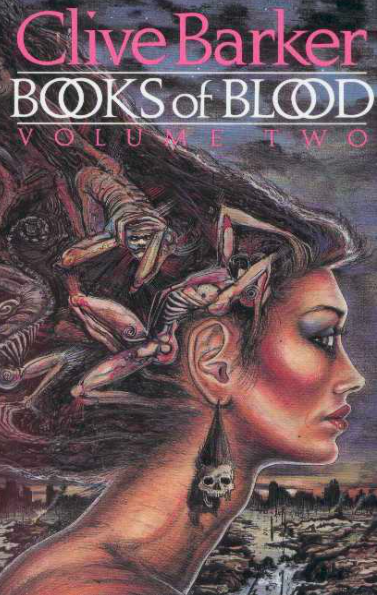
The Books of Blood by Clive Barker have long been a favorite story collection — one of the first I read that made me realize just how “creative” horror writing could be — they really embody Clive’s mantra that “there are no limits” when it comes to the imagination.  And when I say long, I mean since they first came out back in 1984.  I’m elated to see that Hulu has produced a series based on them — it’s about time for a Clive resurgence!

But I’m choosing the Books of Blood because there’s a particular story in one of them (Volume 2, to be precise) that had a profound influence on me.  It changed the way I understand (and write) horror fiction — and it’s since become a staple in my teaching of horror as a college professor.

The story is “Dread,” and it’s one of the greatest horror stories ever written.

What did you decide to make to pair with the book, and what from the book inspired your delicious treat?

I’m no chef, but like many people during the pandemic, I’ve discovered pleasure in experimenting with food and enjoying the results of whatever I can concoct.  So when I saw you were running the “Delicious Horror” series, I was inspired to try something new.  And for the sole purpose of honoring Clive Barker, I have created something…evil.  I call it DREAD STEAK.

Barker’s story includes a very devious scene of sadism, in which the story’s philosophically morbid and evil villain, Quaid, tortures an overweight vegetarian who is dying of starvation in a room he’s locked her up in. He gives her nothing to eat; just water, and, “On the table, on an unpatterned plate, a slab of meat” with a bone sticking out of it. A stern vegan, she refuses to eat the meat on principle, but as the days pass by, her hunger breaks down her defiance, which degrades in concert with the steak that gets more and more rancid as the days go by… until she can resist no more, and eats the horrifying, bug egg-riddled slab of “meat” for survival, sitting on the floor “like a primitive in her cave.”

The story is cruel…and as ingenious as something Poe might write, if he were alive today.

It deserves a corresponding dish.

Can you share the recipe or a link to the recipe?

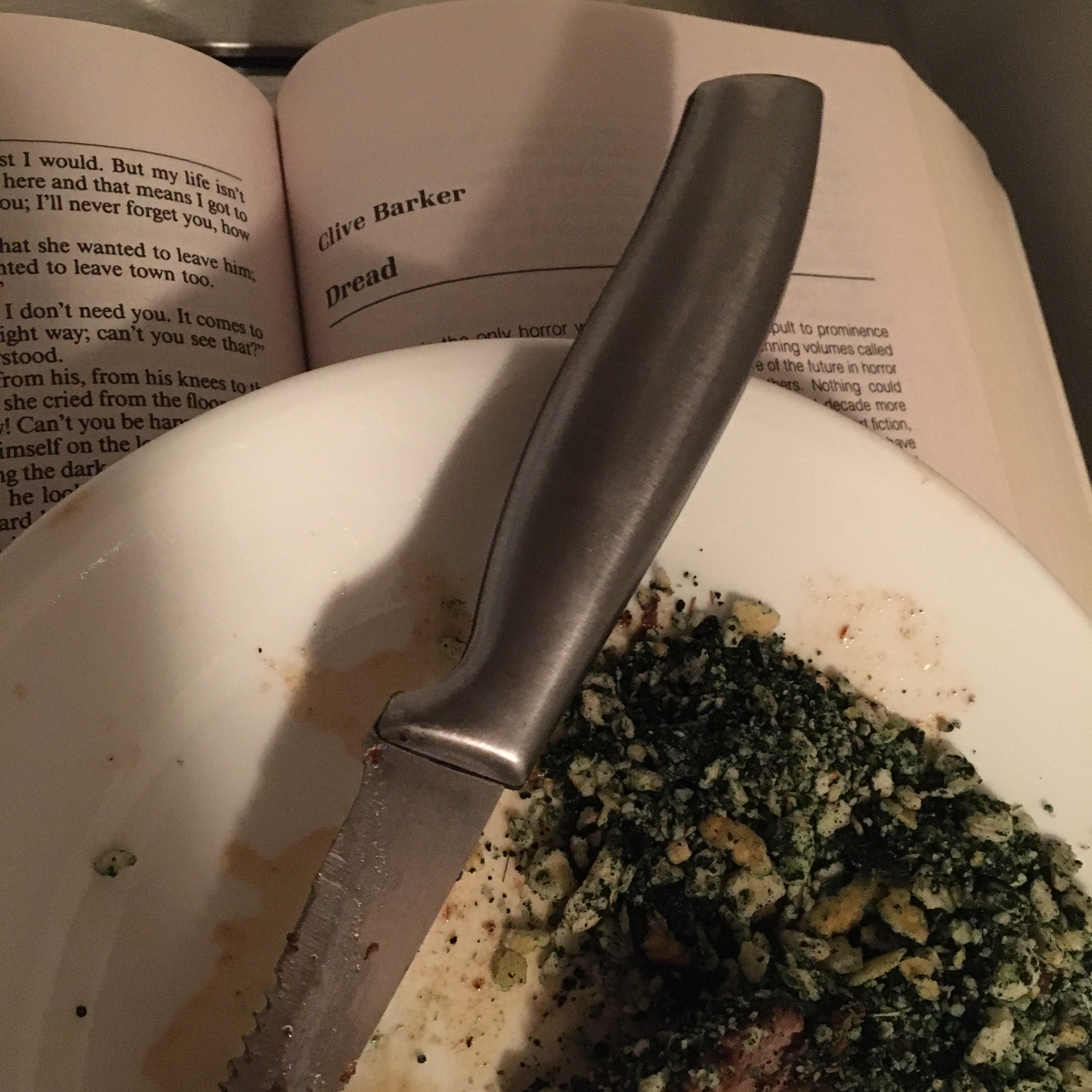
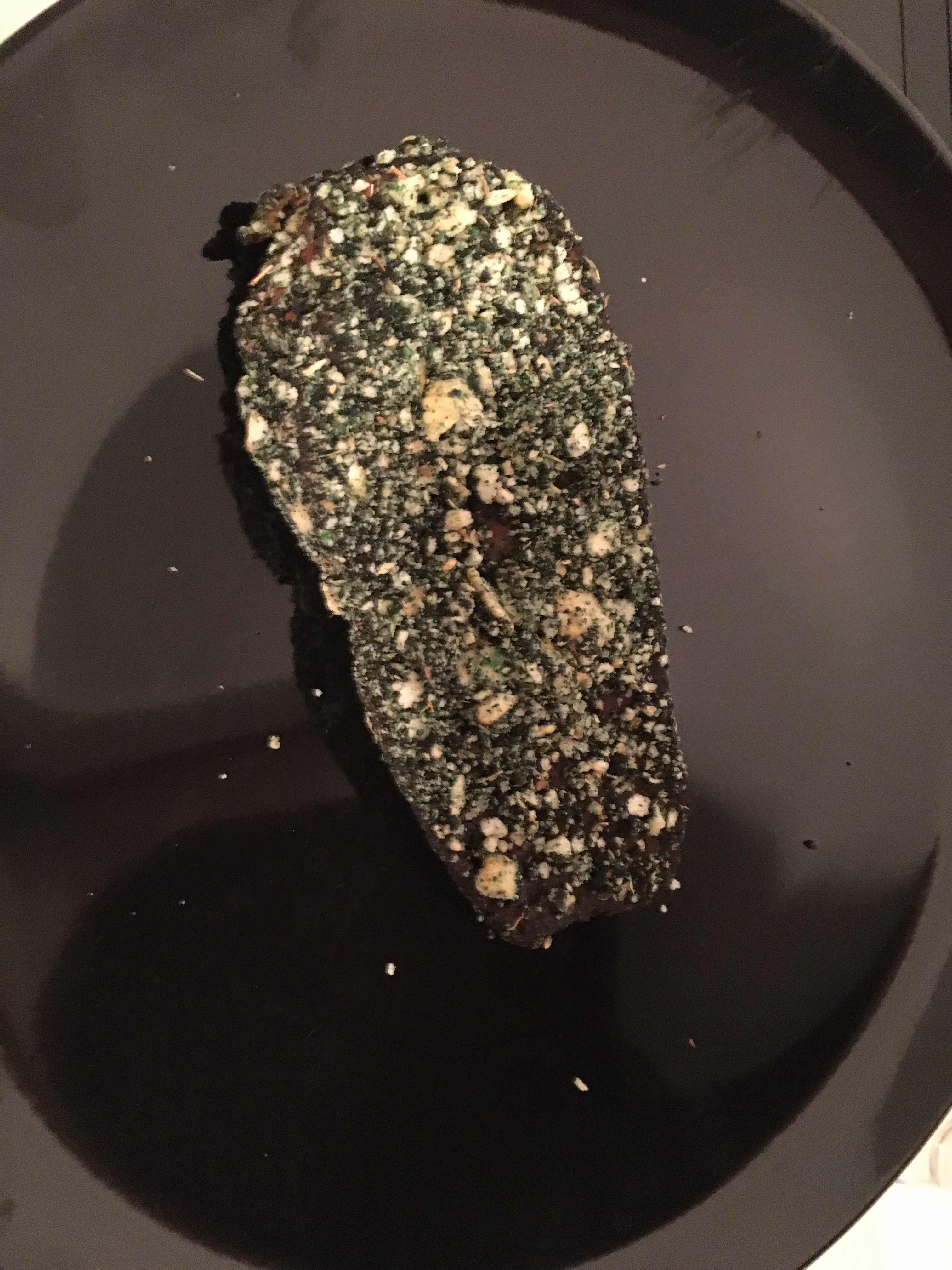
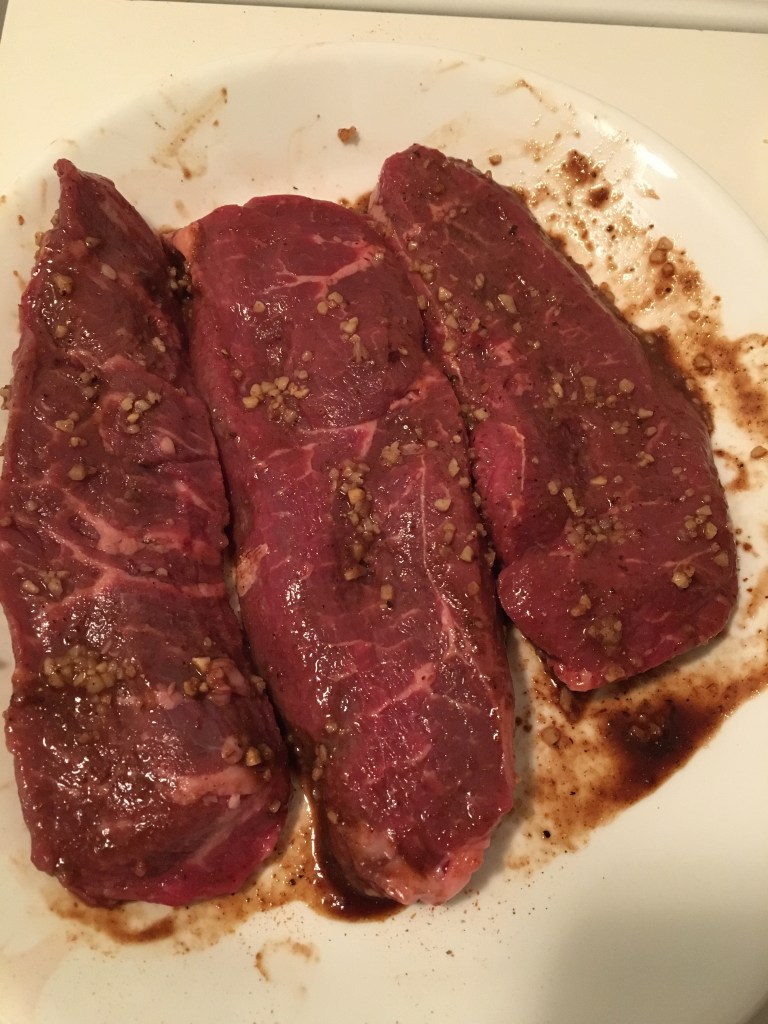
Dread Steak is prepared simply, just like any steak you might sear to perfection in a pan. But with a twist:  the steak must appear ROTTEN AND MOLDY when placed on the plate.  Rancid-looking with the appearance of fly-eggs or maggots.  And yet it must taste really good.  This can easily be achieved with a little playful trickery that’s not too difficult to pull off… and I have a feeling your readers would easily be able to surpass what I did by taking it to another level. But here’s how I did it, with photos — much like Quaid’s snapshots of his victim’s agony — taken along the way:

Ingredients:

1 tablespoon minced garlic

2 tablespoons steak sauce (A1 works nicely)

2 tablespoon unsalted butter

Green and Black and Blue Food Dye (can substitute any raw/green seasoning herbs)

A dozen or more crackers (preferably a sleeve of Ritz)

2-4 sirloin steaks (bonus points if you can find or cut them into coffin-like shapes)

Preparation:

First, you’ll just be cooking a steak as you normally might do it in a frying pan.

Prepare the sirloin beforehand by “buttering” the meat with 2 teaspoons of minced garlic, spread copiously so that the pieces of clove look like pustules.  Then heavily marinate the beef in A1 Steak Sauce, sprinkled with salt, pepper and (very optional) a dash of old bay for flavor. Massage these ingredients into the meat and let sit for ten minutes; longer is fine, and purists might leave it covered on a plate in the fridge to marinate overnight. (Clive’s protagonist would leave to marinate in warm open air for several days until reeking and rotten… avoid that, unless you want an extra dash of Bovine Spongiform Encephalitis).

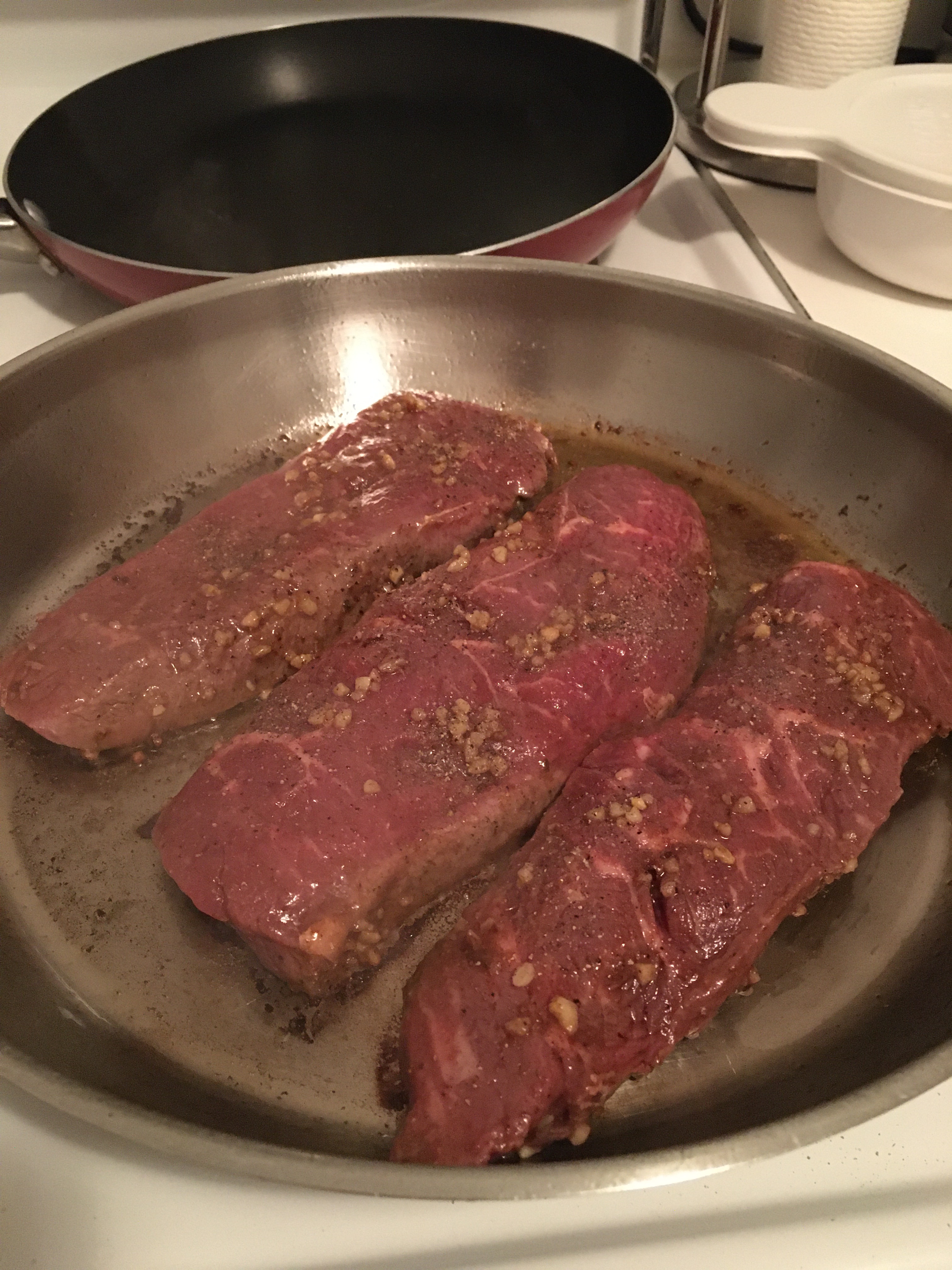
Next get your large frying pan ready by cranking the oven top to medium heat, simmering up the oil in the pan until it has a nice glistening sheen of heat on it.  Once the oil is warmed up, gently lay the cutlets into the oil and let them sizzle for a good three minutes.

It should be nicely browned on the edges by now.  Flip steak once at this point (i.e. after 3-4 mins) to sear the other side. Trick: Press against edges of pan to brown the edges of the meat.  Cover with lid or another pan to retain heat and ensure cook-through.

While this is happening, you might want to prep your mold (though it might be easier to do this in advance).

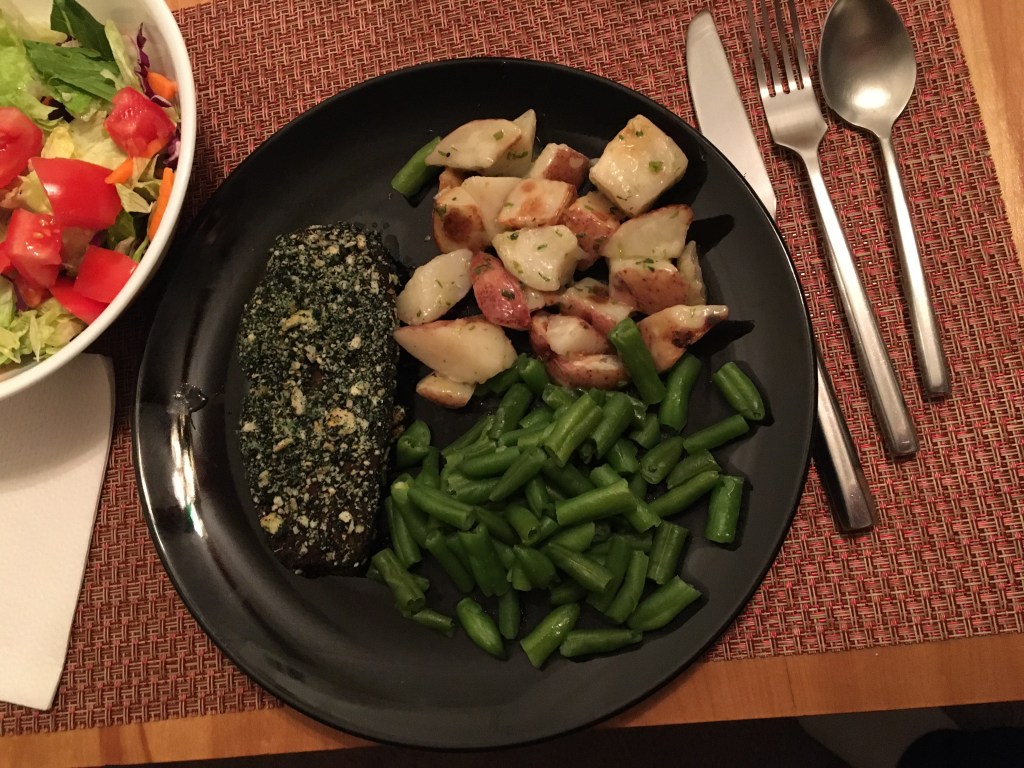
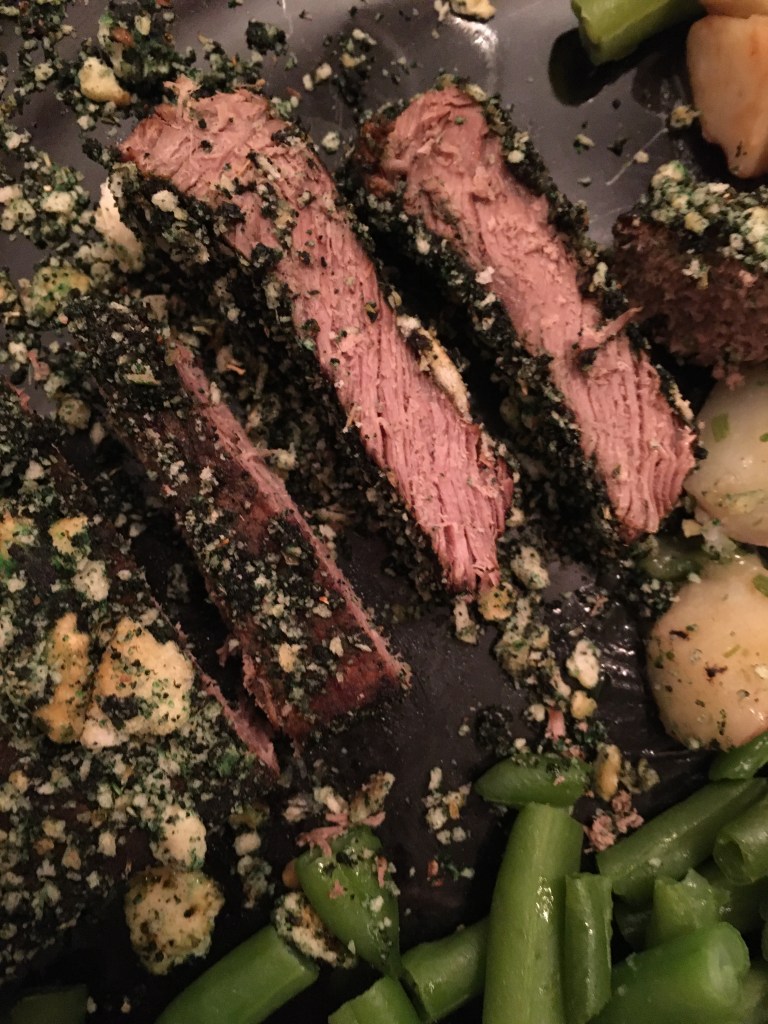
For me, that meant emptying half-a-sleeve of Ritz crackers into a plastic food bag (aka “ziplock”) and crushing them into fine crumbs with many violent punches against the countertop. Then I added a teaspoon of oregano.  You might add your own dried or fresh green herbs to the bag, to taste.  Anything that might resemble green fuzz and fly eggs, but be careful about flavors.  I next carefully added about ten droplets of green coloring and shook. After the green was evenly disbursed, I added another five droplets of black color.  I neglected to acquire blue food dye, but I would have included that in the mix too.  I chose food coloring, so as not to interfere with the flavor of the A1 marinade.  Shake and squeeze and work the dye around the bag so that the cracker bits are as evenly coated as you can get them. There can be white crumbs… the batch does not need to be entirely saturated… and the tiny white pearls of crumb only add to it.

Remove your steak from heat and let sit for one minute. When it’s cooled a bit, drop the steak into your plastic bag of “mold” and shake it around, ensuring the entire cutlet is coated.  It should stick just fine to the oils of the cooked steak but you might need to squeeze it inside the bag a little to ensure full coverage. This will look and feel gross.

That’s really the whole gimmick.  It tasted great, and since the crumble was uncooked it didn’t feel “breaded” like a baked or fried coating (which often would use egg as glue) would feel. However, the dye did leave some staining.  If the reader is wanting to avoid artifice, then a foodie substitute might just be pure oregano and other Italian herbs.  But this might result in an unpalatably herbaceous flavor if you’re not careful.

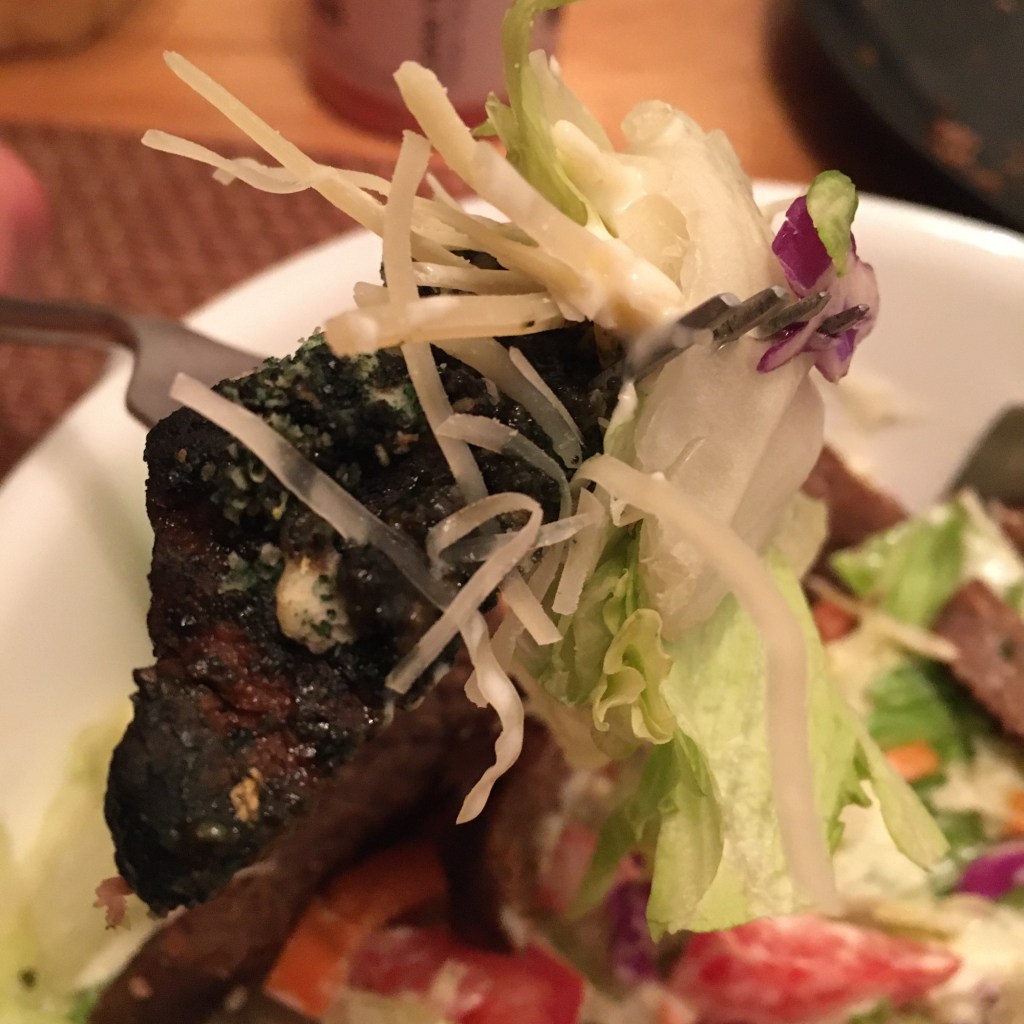
I enjoyed my steak with roasted red potatoes (since Quaid does eventually give his victim potatoes after she eats his meat) and a salad on the side. It occurred to me that the steak could easily be cut into strips and placed into the salad bowl, making a DREAD STEAK SALAD alternative that is drizzled with a fine dose of irony.

Bon appetite!  There is no delight the equal of dread…steak.
Delicious Horror: John Edward Lawson

Today I have the very talented and very kind John Edward Lawson on my blog with a wonderful contribution to Delicious Horror! I’m very excited to share what he made below — enjoy! And check out submission guidelines here if you want to contribute to Delicious Horror yourself!

Although John Edward Lawson has been called “the forgotten Black man of horror” his novels, short fiction, and poetry span all genres. His writing has garnered nominations for the Dwarf Stars, Elgin, Rhysling, Stoker, and Wonderland Awards, as well as the Puschcart Prize.

John has released five horror soundtrack-influenced metal singles over the last year, and his horror photography is also available online. When he is not creating new works or traveling for events he is busy leading workshops at Broadkill Writers Resort.

In addition to being a founder of Raw Dog Screaming Press, former editor-in-chief of The Dream People, and editor of six anthologies, he currently serves as vice president of Diverse Writers and Artists of Speculative Fiction and has been organizing virtual events through AllAccessCon since late 2019.

John is a member of the Horror Writers Association, International Association of Innovation Professionals, Internet Marketers Association, and Nonfiction Authors Association. You can connect with John on Instagram, Goodreads, Twitter, and LinkedIn. Spy on him at https://johnlawson.org/

Tell us what horror book you chose to highlight and why it’s a favorite of yours:

The book I chose to highlight is a translation: Audition by Ryu Murakami. Yes, more than just being one of the films credited with launching the “J-Horror” craze there is actual source material in the form of a novel.

Audition is the story of a widower named Aoyama, and his film producer friend’s scheme to get him a new wife by holding auditions for a fake movie, which is how he meets a young woman named Yamasaki Asami. That totally sounds more like the set-up for a questionable romantic comedy as opposed to horror, but let’s just say things don’t go as expected.

It’s difficult to totally hate or totally like anybody in the story, except maybe the dog Gangsta, and I’m a fan of characters that live in the gray area. Also, it’s excruciating in the way that romantic comedies can be, with it being painfully clear to see how things could go well, how things could even maybe have a perfect ending, except: horror. It’s been 19 years since I first saw the film, then read the book, but I hadn’t seen a story done this way before and it made a huge impression on me.

In terms of currently being timely, there’s a moment when characters bond over the outsider experience of attempting to partake in society by way of dining out. “At it’s worst it’s a culture of collusion,” Aoyama tells Asami, going on to add, “…you need courage to walk into a place like that. It’s a tight-knit little community, and harmony is of the utmost importance.”

I found this relatable on so many levels despite the fact that eating in public is meant to be a communal experience, at least by sociological standards. Now, though? Who isn’t dying for a return to some semblance of normal public awkwardness? Who wouldn’t breathe a sigh of relief to be part of the out crowd publicly dining at the fringe while others take up all the air in the restaurant?

Audition is a story of social isolation, manipulation, naïvité, and unexpected, irreparable harm…things many of us associate with our childhood. It’s like the COVID-19 pandemic in that regard, forcing us to explore this difficult to navigate world through a disenfranchised and powerless perspective. It’s no wonder so many of us are trying to rebel against authority figures amidst all this chaos.

And above all Audition’s antagonist — if you want to call her that — is guided by childlike simplicity.

What did you decide to make to pair with the book, and what from the book inspired your delicious treat?

For me the final quarter of the year is what I most strongly associate with childhood, starting with Halloween. My family was poor and only ran our gas oven during the cold months, in part to reduce air conditioning costs during summer but also to warm the home as autumn slowly decayed into winter. That meant baking sweets and casseroles and squashes and, among many other things, one of our family favorites: rumaki.

My mother was fond of hyping up the Japanese origins of the dish, in particular so she could then run down sushi and unsanitary and unsavory while somehow ignoring the fact Japanese cuisine includes so much else. Of course, as an adult I have learned that rumaki was likely concocted by Victor Jules Bergeron, Jr. — a.k.a. Trader Vic — at his Don the Beachcomber restaurant in California, as its first appearance was in their 1941 menu. Some form of the food itself might have come from Japan by way of Hawai‘i, and the name is likely an Americanized version of “harumaki,” the Japanese spring roll.

In this way rumaki goes perfectly with Audition because it is a delightful fraudulence that might be unhealthy in large amounts, not unlike a certain deceptive character in the book. And when it comes to the book, as you might expect with an adaptation, there are things left out of the film. One such element is Aoyama’s obsession with the traditional Christian pipe organ music of Germany, in particular orchestrating a concert for a specific organist from Wittenberg, in the former East Germany, to record a documentary about. Why pipe organs? No idea, but it certainly stood out to me.

“Organs.”

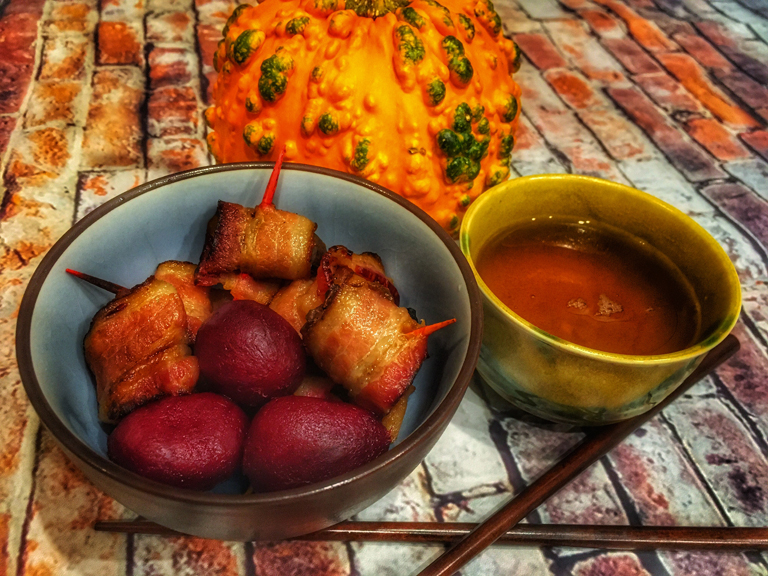
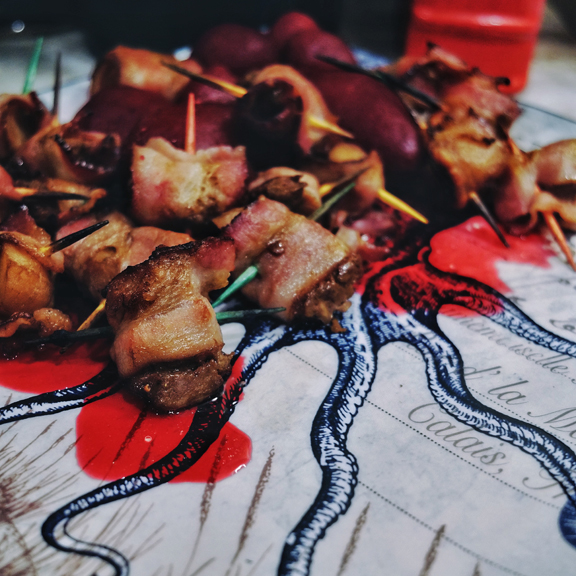
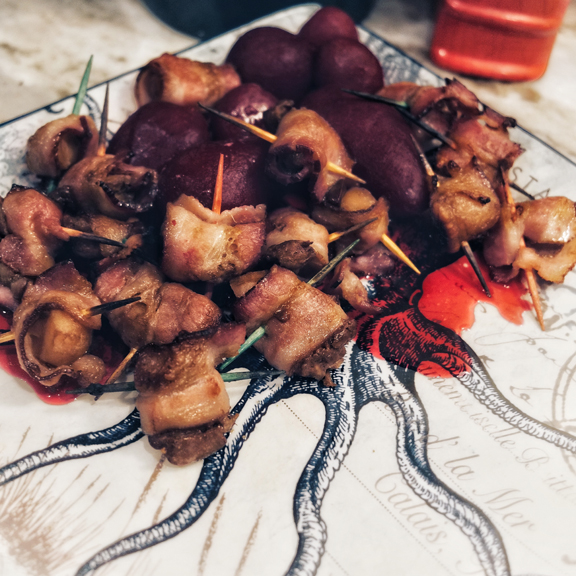
Naturally, the way my mind works, I think of literal organs such as chicken livers, and what non-meat substitutes we might find for internal organs. Hence the addition of canned beets. Sure, I love roasting fresh beets, but few foods are as visually visceral as lumps of beet-flesh in the spilled liquid they are packed with, that rich maroon eerily reminiscent of large, freshly spilled quantities of blood that haven’t yet had time to react fully to the oxygen-rich air.

Just like that which was splashed across the news segments of my childhood rife with wounded soldiers, bodies left behind by terrorist or government massacres, and the remnants of car accidents in the background as journalists with butterfly collars and earth-tone jackets tried to work their way up the local media food chain by somberly reciting details of the incidents. The 1970s were wild like that.

Can you share the recipe or a link to the recipe?

·  3 tbsp. soy sauce

·  1 tbsp. brown sugar

·  4 chicken livers, cut into thirds

·  3 water chestnuts, quartered

·  4 strips bacon, cut into thirds

·  1 (1″) piece fresh ginger finely chopped or grated

You’ll find fatty membranes, stringy sinew, and various clumps and blobs attached to the chicken livers. Go ahead and trim all of that off with a knife when cutting the livers into thirds; if it doesn’t look like a liver then it’s not part of what you’re meant to be eating.

Whisk the soy sauce, brown sugar, and ginger in a medium bowl. Add water chestnuts and chicken livers, tossing to coat; place in refrigerator to let marinate for 1 hour.

While preheating your oven to 400° strain the liver and chestnuts, reserving the marinade. Bring the marinade to a boil in a 1-quart saucepan; set aside.

Place 1 slice of bacon on a cutting board, then top with 1 piece of liver and 1 water chestnut. Wrap bacon around liver and chestnut; skewer bacon in place with a toothpick. Repeat process with remaining livers, water chestnuts, and bacon.

Transfer rumaki to a wire rack on a baking tray or cookie sheet lined with parchment or foil for easier clean up.

Bake at 400° for 15 to 20 minutes occasionally basting with the marinade. The bacon should be golden brown and, if cut open, the liver should be

If you want to take things over the top use a pastry/paintbrush to add a glaze — it should be noted that’s not what’s pictured here. While some people advocate all sorts of dipping sauces I’m not a fan since the marinate is already so strong without totally obliterating the natural flavors.

Variations: a Kosher alternate to this bacon-based recipe is to wrap the liver and chestnut in pastrami, and vegetarian options include pineapple or marinated watermelon in place of the liver and extra firm tofu pressed for 30 minutes in place of bacon (not something I’ve attempted, so I’m not sure if the tofu is just added to the skewer or actually wrapped around the other ingredients). Brown sugar substitutions that work well in this recipe are agave or honey.

As for the canned beets, although you can eat them straight from the can I prefer them heated in a saucepan; if you are not using pickled beets I strongly recommend saving the beetroot juice the beets are packed in for use with other recipes, as a natural dye, or for staging a crime scene.

Delicious Horror: Hailey Piper

Happy Wednesday, spooky friends! Can you believe we’re three days away from Halloween? This month seriously went by in a blink. To help us count down to Halloween, Hailey Piper is here with a recommended horror read and one of my favorite desserts! Hailey also has a wonderful story in Not All Monsters, which was just released yesterday!

Hailey Piper is the author of The Possession of Natalie GlasgowAn Invitation to Darkness, and Benny Rose, the Cannibal King. She’s a member of the HWA, and her short fiction pops up in Daily Science Fiction, The Arcanist, Flash Fiction Online, Year’s Best Hardcore Horror, and elsewhere. She lives with her wife in Maryland, where they sometimes bake monstrosities of the living dead. Find her on Twitter via @HaileyPiperSays or at www.haileypiper.com.

From Hailey: My new cosmic horror novella The Worm and His Kings releases on November 15 from Off Limits Press! A swirl of shadowy monsters, creepy cultists, and a woman trying to find her missing girlfriend in a subterranean world beneath 1990 Manhattan. Paperback pre-orders are up at the Off Limits Press site.

Tell us what horror book you chose to highlight and why it’s a favorite of yours:

I chose White Is for Witching by Helen Oyeyemi as my Delicious Treats book. In some ways, it’s about a troubled young woman Miranda Silver and her family, but it’s also about the terrible Silver House where they live and operate a bed-and-breakfast, and it’s also about another young woman, Ore Lind, with troubles of her own. But it’s also very much about sicknesses that spread and linger in families, racism as a legacy. White Is for Witching demands close attention; it is a dense, beautiful, haunting novel.

What did you decide to make to pair with the book, and what from the book inspired your delicious treat?

Warning: my treat offering isn’t exactly deep! In the novel, Miranda suffers from pica, a condition that compels a person to eat inedible things such as plastic or dirt. Miranda’s number one go-to pica craving is chalk. To that end, my wife and I made lemon bars coated in white confectioner’s sugar. Cut thin as shown here, they’re slivers of chalk that are perfectly safe to eat!

Can you share the recipe or a link to the recipe?

For this recipe, you’ll need:
CRUST
1 cup all-purpose flour
1/2 cup butter, softened
1/4 cup confectioner’s sugar

In a bowl, combine flour, butter, and confectioner’s sugar. Pat into an 8×8 baking pan. Bake at 350 degrees F for 20 minutes.

FILLING
2 large eggs
1 cup sugar
2 tablespoons all-purpose flour
1/2 teaspoon baking powder
2 tablespoons lemon juice
1 teaspoon grated lemon zest

Beat eggs, and then add other ingredients. Whip until frothy and pour into the cooked crust’s pan. Bake 25 minutes. Dust the top with confectioner’s sugar (much or little as desired). Let cool for 1 hour in the fridge for ease of cutting.

Thank you for having me, Sara!

Thank you so much, Hailey! I already want to make these as we plunge deeper into these wintery months. Lemon bars feel perfect for the season.

Check out submission guidelines here if you want to contribute to Delicious Horror! See you all tomorrow with another very delicious post.